Showing posts with label new orleans. Show all posts

Sunday, April 23, 2006

NOLA Work: What I Did (A Long But Worthwhile Post)

My first day of work was last Friday. I went out with a gut crew to a 'new' house; it had not been visited yet. In fact, it had not been touched since the flood.

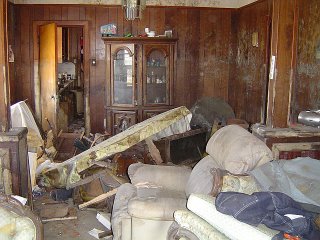
The furniture was strewn all over. Personal effects--letters, medicine, toys, photos--were tossed around on the floor. It reminded me that though it must have been extremely tough to leave all your worldly possessions behind, it's more important to make sure everyone survives.

Clothes and bedding littered and clogged the bedroom floors. Everything was piled haphazardly on everything else by the ruthless waters.

The water lines were clear. Mold and mildew stained not only the walls and items below the water lines, but continued creeping up, all the way to the ceiling. It was especially noticable when we got down to the sheetrock.

It took all morning to empty the house. It was hot and humid, and we had to wear long pants, gloves and respirator masks. It was hot and sweaty in the mask, and it also felt like you weren't getting a full breath, since the air was only coming in the pink filters.
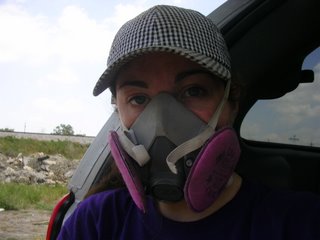

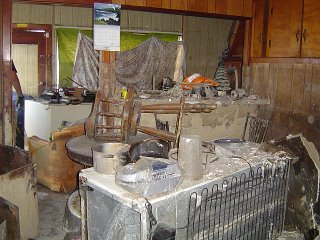
I was already exhausted by lunchtime. After lunch we had to clear out the work shed, which was crammed with ruined tools and books, dishes and other stored items. Many of them still held the fetid water from last summer.

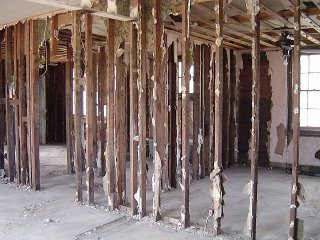
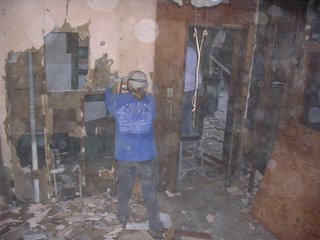
Then the real work began: the gutting. First we had to tear down the wood paneling, which of course had to be preceded by removing the molding at the tops and bottoms of the walls. Then we took crowbars and hammers to the paneling and tore it down in big sheets. Very satisfying. Finally, when all the fake wall was gone, it was time to get rid of the moldy sheetrock.

By this time, I'd already had to take at least one break. Working in the heat like that had really done a number on me. Perhaps it was a migraine, or a touch of heat stroke, or pure wimpiness. But my head throbbed, my stomach was queasy, my eyeballs ached, I felt lightheaded. Oh, it was awful.

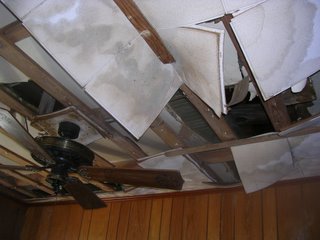
For nearly an hour, I quietly and methodically hammered down sheetrock. It was immensely satisfying. It was disgusting, seeing the damage the floodwaters had done to materials all the way to the ceiling. The ceiling itself had fallen in many places, actually. As you can see, the air was thick with dust and particles. We were grateful for the nasty masks.
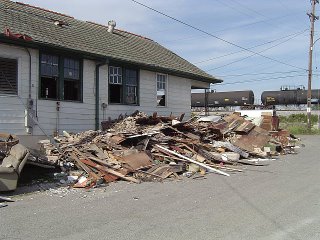
All the furniture, personal items, walls, sheetrock, insulation, and everything else went out the doors and windows, piled up on the curb outside the house. The pile grew in length and height throughout the day.
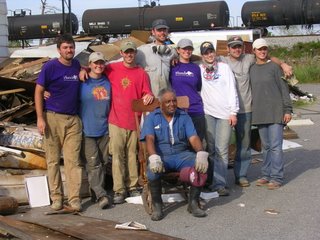
The family who owned the house was there the whole day, helping out and chatting with us. They had owned the house for thirty-seven years and raised five kids. They were in their seventies and just the sweetest southern old folks you could ever meet.
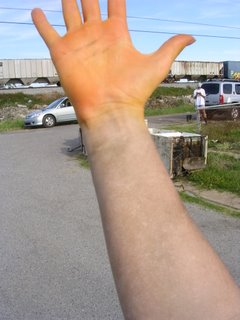
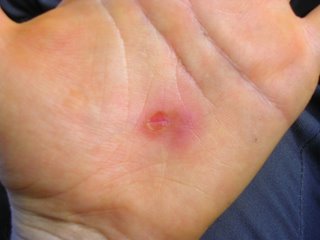
I took several more breaks throughout the afternoon, doing my best to head back to work once I felt marginally human again each time. I didn't have the energy to talk, or bend or move much, but I did what I could. I helped clean up and soon enough our day was over. We were all exhausted, dirty, sweaty, and smelly. I'd begun the day with all new work clothes, but by the end, oh man was it all broken in, but good. My lovely new gloves dyed my hands yellow/orange. And that is a very dirty arm (I am very pale under there).
As soon as we got back to base camp, out of the heat and out of the work clothes, I immediately began to feel better. The headache didn't really go away, but it did lessen after I took some pain relievers.

This was all just my first day working.

Day Two, Saturday, was finishing up gutting a house, and it was just a morning with a small group of us. I spent most of the time perched on a ladder, removing nails from the ceiling with a hammer. It was a pretty easy half day after the ass-kicking day before.

Sunday was Easter, and it was also the lull between volunteer people, so camp was pretty deserted.

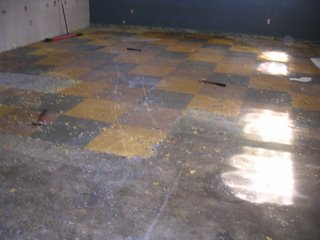
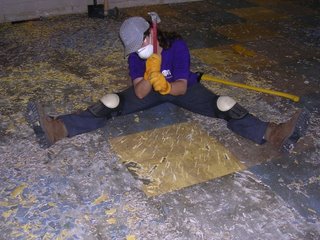
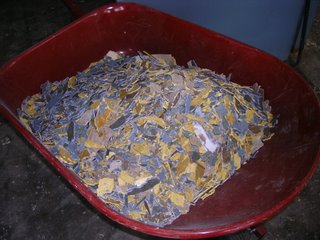
Monday I joined four others in traveling to a Boys and Girls Club, where our task seemed to be fairly easy: getting tile up off of two floors.

However. The tile was some kind of wood laminate that was very well glued down to the floor. We tried using crowbars, sledgehammers, axes, a metal broom thing, but the best way was just to hack at it with hammer prongs. So we sat on the floor for a whole day, banging away at the floor. We all developed blisters and sore hands and wrists. It was slow-going, tedious work, and we were also very, very sweaty and smelly by the end. We didn't even get half of one floor done, but we did pretty well for being such a shitty job.

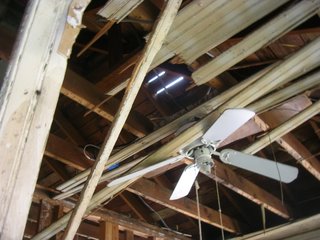
Day Whatever-is-next was Tuesday, when a group went back to the first house I was at. We had to finish it up: take out the ceilings, take out the bathroom tiles, rip up the flooring. It was a tiring day. I was one of the people who went up to the attic/crawlspace. The ceiling there consisted of wooden planks nailed to the support beams, so I couldn't just stomp them down. I used a hammer to loosen the nails and then hit or kicked them down. I had to be careful, shifting between the support beams a foot and a half apart. But it was fun. I made a big mess, and it was extremely satisfying when a long plank crashed down to the floor. It was not so fun to push down all the crumbly insulation, however.
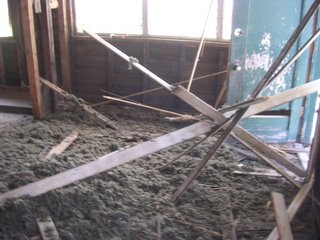
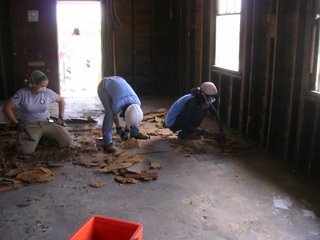
I made sure to take breaks every hour, but by early afternoon the migraine/heat stroke hit me again. We were all worn out but got the floor in this whole room up. Loud work that was not made easier by my sore hands and blisters from the day before.

I have so much respect and love for the long-term volunteers in the Gulf Coast. People have been there for weeks or months, working their asses off in awful conditions. They are really making a difference. AmeriCorps NCCC teams are all over the place. The team at Hands On New Orleans right now will be switching out with another team in a few weeks. They're the ones that got the operation up and running smoothly. Talk about heroes!

Next post will be about the fun and the sight-seeing. It was not all sadness and hard work. There was plenty of exploration, laughter, comaraderie, and good times.

Friday, April 21, 2006

"The Big Easy"? Thoughts, in no particular order


I have been home for a day and a half now. The situation in New Orleans seems to have a more powerful impact now that I've left. Perhaps that while there, it was so commonplace, and so many people had seen much worse, that I was almost taking it for granted.

Public schools reopened on Tuesday. This week. EIGHT months after the hurricane. Two months ago--six months after the hurricane--most stoplights weren't working and trashed/flooded cars and other debris still littered the streets. Now, most stoplights work and the streets are fairly clear. Plenty of roads were themselves damaged by the waters, and you still saw lots of stranded cars along the sides of streets, but overall things were fairly normalized.

Buildings are still intact in New Orleans; it's not the utter destruction that the Mississippi Coast saw. However, the water lines go forever in some neighborhoods. Some neighborhoods have no water lines at all. The city was built on different heights depending on class. The plantation and slave-owners' houses are built on higher land, and the slave quarters were built on the lower land. Those class distinctions from 150 years have carried over to now, so that the poor were overproportionally affected by the floods. Of course, there were plenty of middle-class homes affected too; they just didn't show that on tv.


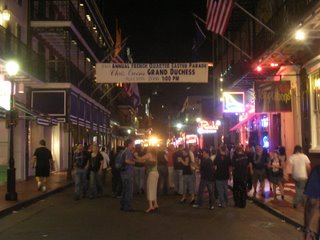
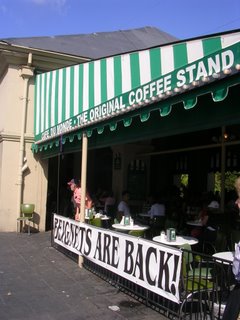
At first I thought that things were livening up. You saw cars driving, lights on, people walking--IF you went to Canal Street or the French Quarter. Even so, many shops and other businesses are still closed. I saw more people in one block of Queens yesterday than I did on Wednesday afternoon on the whole of Canal Street, which is a long main thoroughfare running north-south. Cafe du Monde (above) is back serving their famous beignets (squares of fried dough covered in powdered sugar), and Bourbon Street is 'open.' However, I know that they are relatively empty compared to the pre-hurricane economy. Most, not all, bars are open, but most of them also stood empty.


The heat is already oppressive, especially to my sensitive temperate-climate-raised notions. I kept forgetting that it's only mid-April. Also, the hurricane season starts in June. Again.

Hands On has been a huge presence in the Biloxi/Gulfport area since October or November. In general, there are tons of volunteers and groups helping out over there, and not nearly as many in New Orleans. The Hands On chapter only got to New Orleans in February. They're already two months' behind in fulfilling work orders and cannot take anymore. They lead volunteers out to the community and gut damaged houses, at no fee to the homeowner. They also remove and treat for mold.

I worked in one house for several days. The house was raised at least three feet off the ground, and the water line was at least four feet. That means there was at least seven or eight feet of water there. And the damage did not only extend to the things the water touched. Most of the ceiling had fallen down and become part of the floor. The mold grew up the walls to the ceilings.
More on that in another post.


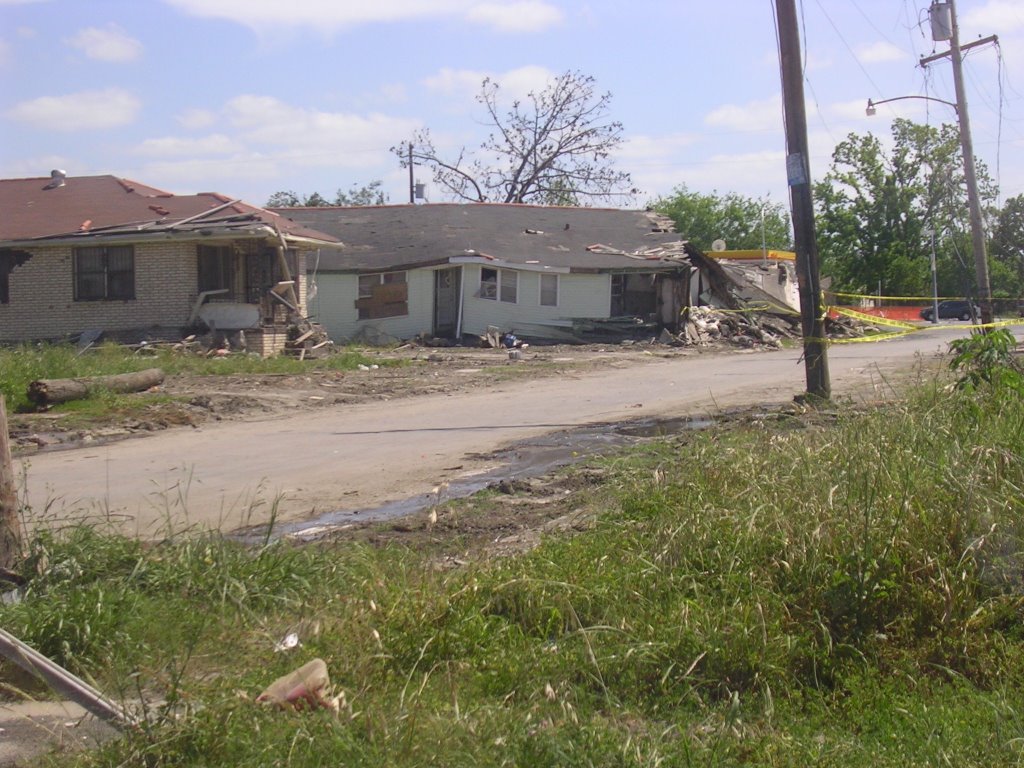
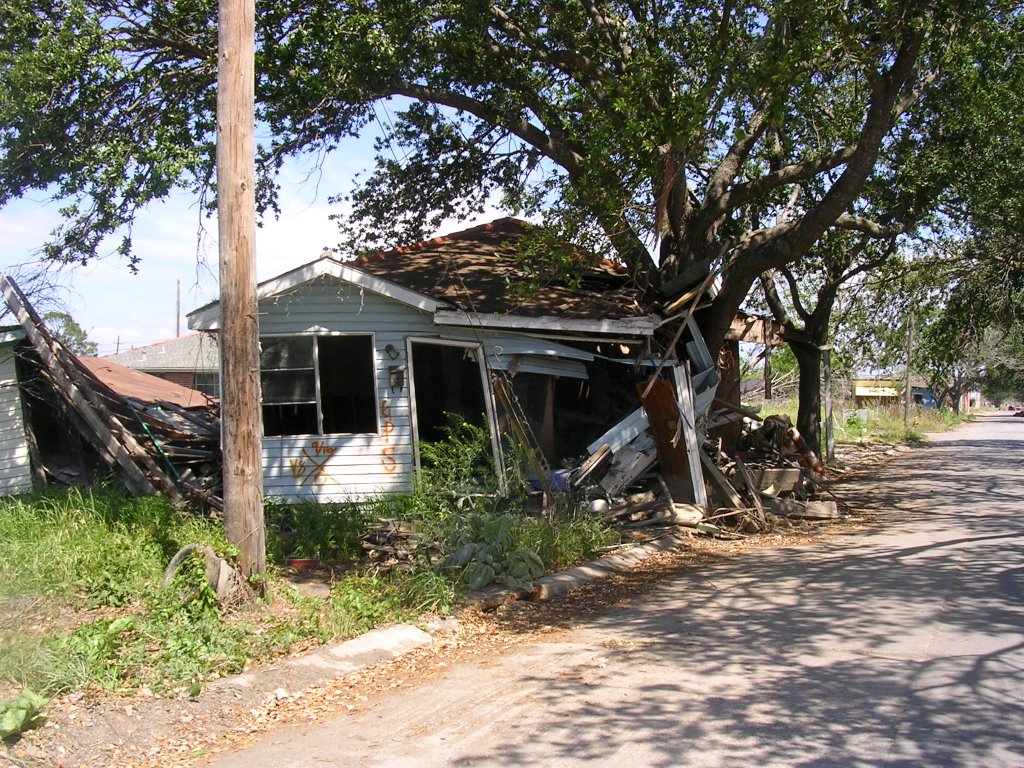
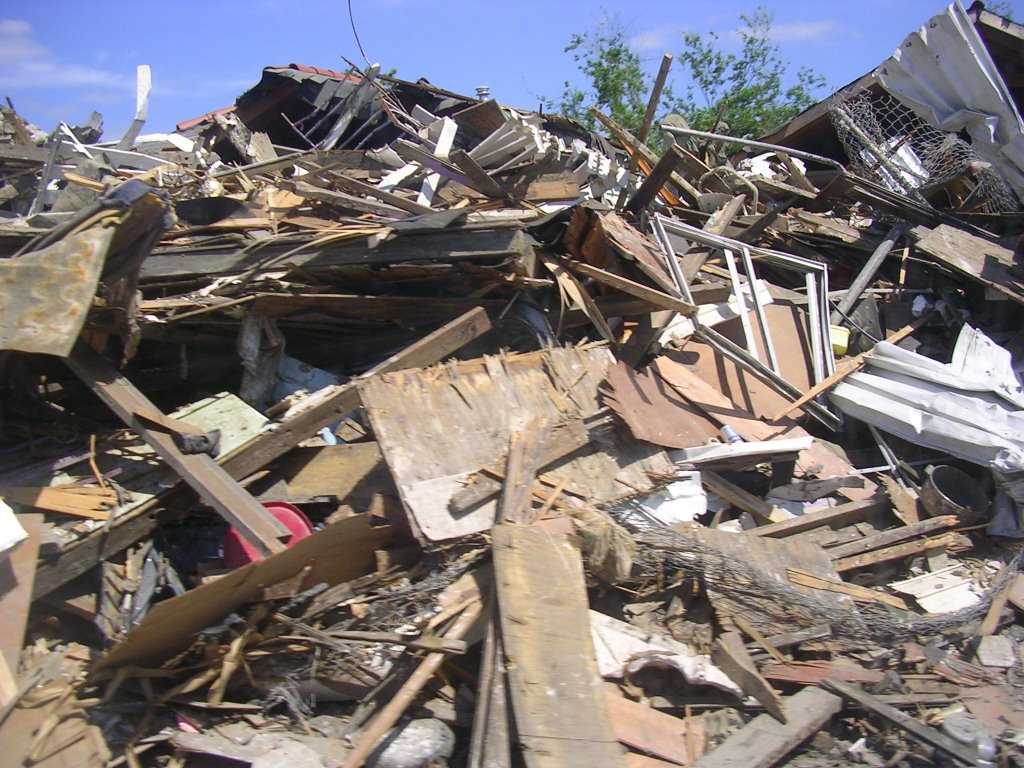
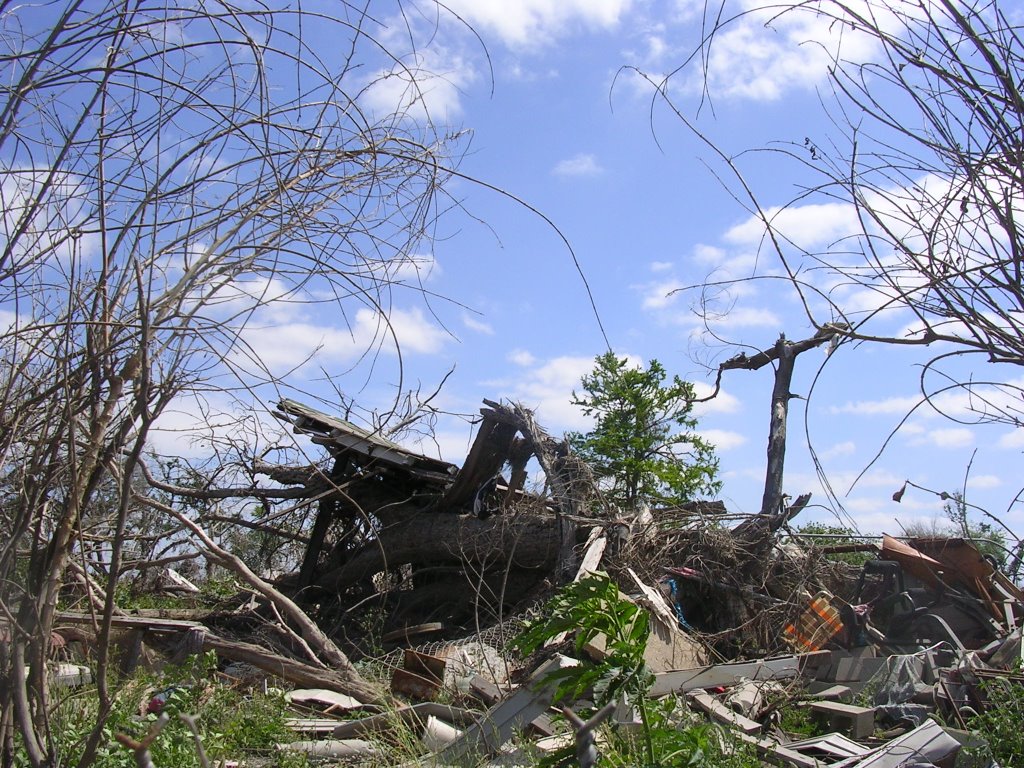
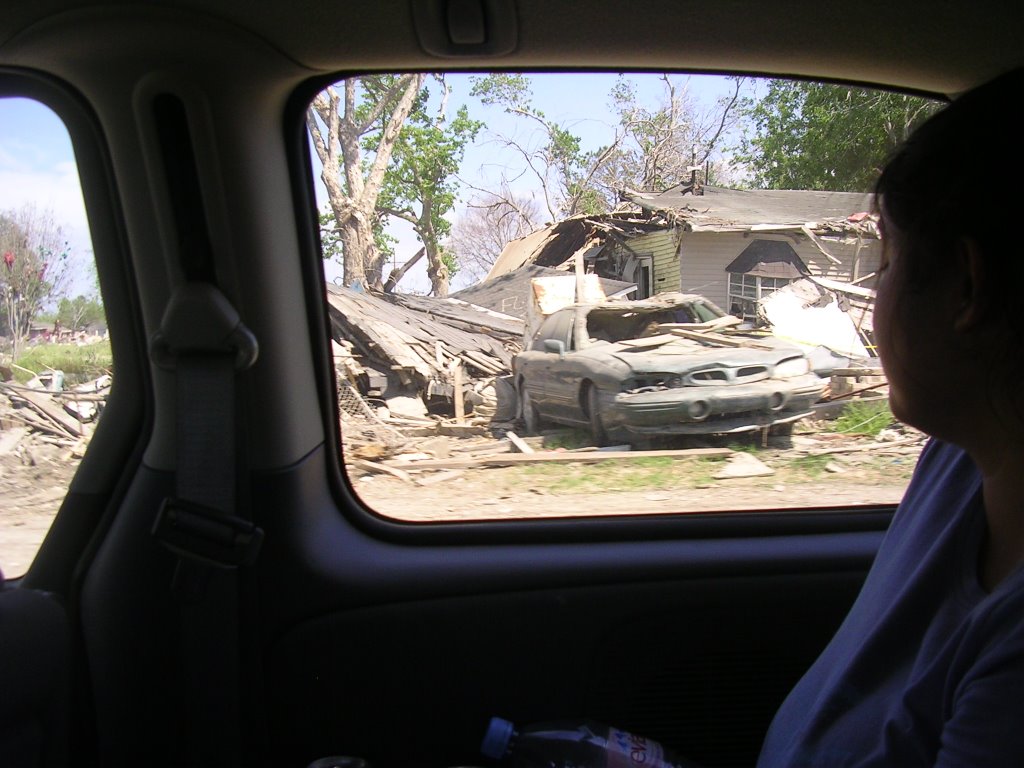
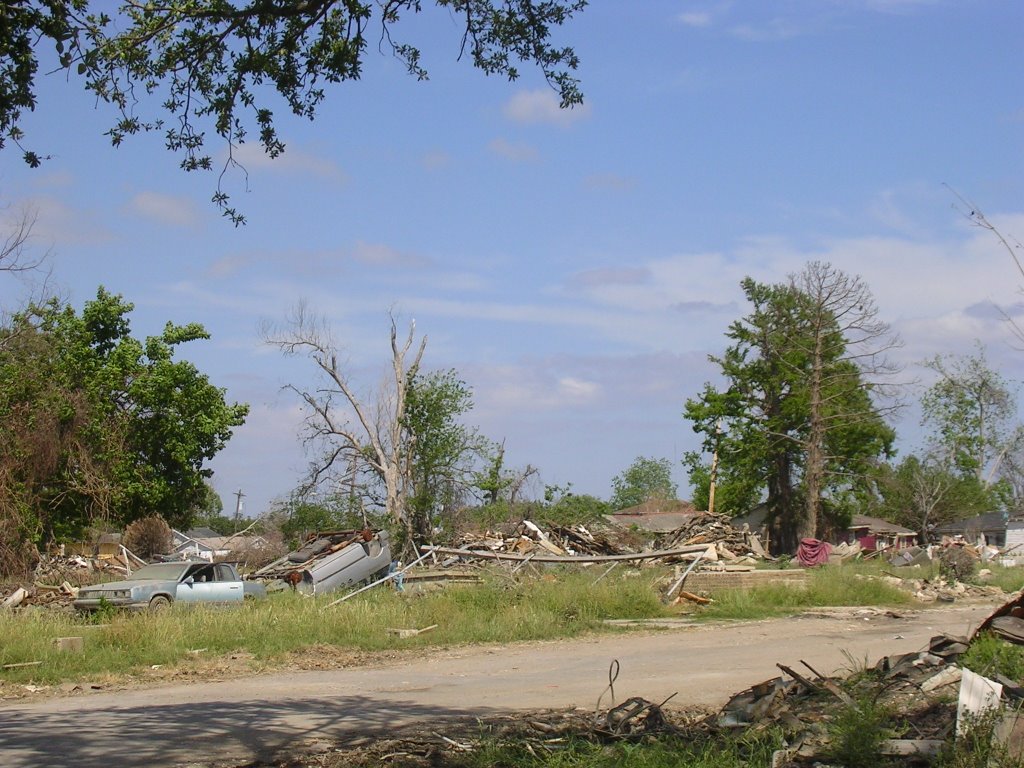
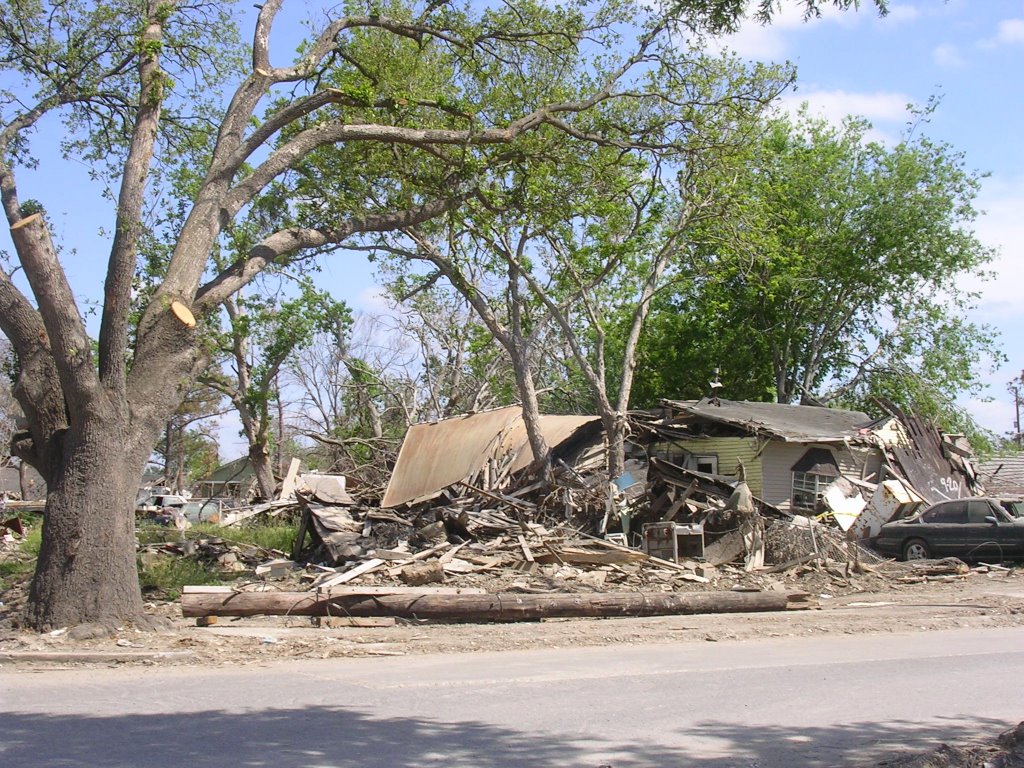
But all that seems almost irrelevant when you consider the Ninth Ward (see next post with pictures). Wards are like neighborhoods or suburbs or something, and the Ninth sits immediately to the east of one of the leveed canals. The gap in the levee was astonishing. I tried to, but could not, imagine what it must have been like when the water breached or broke that levee. A wall of water must have submerged the entire neighborhood within a few minutes. Most of the houses there were not built on real foundations; they were propped up on concrete blocks. When all that water poured in, it just lifted up the houses. Some dropped back down almost on their blocks, sinking in the middle. Other houses were left stranded in streets, or crashed into trees, or crashed into other houses, or just completely demolished into nothing but planks and splinters.

It was unbelievable, surreal, and horrible. Looking at it felt like seeing some kind of natural holocaust, except we know that it's the fault of humans. There were no people there at all. Why would there be? Everything was destroyed, even if the shell of the house was still there. Whole fields and yards lay bare where less than a year ago were residences.

It struck me that some may think taking so many pictures of the destruction is morbid and exploitative. Actually, I believe that it's actually doing something to honor and remember the reality of the situation. A way to remind us of the awful things to help prevent more in the future.

Pictures tell thousands of words: The Ninth Ward of New Orleans, Eight Months Post Katrina


Monday, April 17, 2006

No melancholy here!

I am having a fantastic time here. These people, who work and volunteer here, wow....they do amazing and incredible things, and are so awesomely nice to boot! The group I made friends with (they welcomed me and invited me out with them within an hour of my arrival!) have already sent out emails and pics.

Sunday we had a day off, so two guys and I went out exploring in town in the daylight. The French quarter seems fairly busy with touristy types, and it looks normal. I hear that economy-wise it's still very depressed.

Today is Monday and I went with a team to a Boys and Girls Club they've been working on. Our task was to remove tile from one (possibly two) rooms. The tile was glued down and the only way we could get it up was by bashing it with the prong end of a hammer. It was tedious and difficult labor, but we stuck it out. After lunch we finally got some tunes going and that helped. Someone had a mix cd of mid-90s radio hits, and that was awesome. Counting Crows, Gin Blossoms, Verve Pipe, Blind Melon, that kind of thing. We left around 3, exhausted and worn out. I have two blisters, one on my palm and one inexplicably on the outside of my right pinky. My hands and arms still have the shakes and are sore from gripping a hammer and also an axe. Axing the floor is fun!

Tomorrow is my last full day. I am sad to go. I want to see more and help more. I really want to go to Mississippi, but they have a ton of people in Biloxi, and not as many in New Orleans. Which I think is kind of strange, but anyway.

I have already taken well over 200 photos, and I can't wait to view and post them all!

Though I don't want to come home very much, I am definitely looking forward to Thursday's teacher-blogger event.

Last week I was telling someone about that, but we were in a club (it was 80s night at One-Eyed Jack's), and the girl didn't hear me. She was like, "Teacher logger? Teacher Flogger? What?" Heh.

Friday, April 14, 2006

Wow.

I've been here just over 24 hours. Already I'm amazed: at the amount of damage, at the amount of emptiness, at the friendliness of the locals, at the incredible relief effort happening here, and at the friendliness of the volunteers.

Today I worked on a team with seven other people, and we gutted an entire house. It was very sobering, but joyous too, because we met the family; they were helping out and chatting. It was really hard work, and that plus the heat did a number on me. I had to rest a lot of the afternoon; I've gotten pretty weak in the last few years.

But it's a wonderful experience already. I hope that some of you might find some time to get down here and help out yourselves! They will be rebuilding for a long time and need all the friendly volunteers they can get.

More later!