Unbelievably, I'm going into my sixth year of teaching. That means I have been to a LOT of professional development. Most of it has been a useless waste of time. However! I remain hopeful that it can be done well, and that it can be of use to teachers like it's meant to. Here is my Official Guide to PD. Feel free to add your own in the comments.
1. Workshops should last no more than 1 1/2 hours. Furthermore, teachers should not be sitting in the same room all day long. Parse the PD into different rooms. Once the bum goes numb, so does the brain.
2. When planning PD (as a supervisor or as a presenter), ask yourself the Golden Question: Is this DIRECTLY relevant to classroom teaching? This cannot be emphasized enough. Teachers should be able to think about bringing your content into their practices. Now, whether or not they decide to is another issue, but it should be easy to connect PD workshops to everyday teaching.
3. Encourage participation. It breaks up monotony and keeps people awake. It keeps them accountable for the information, it helps teachers get to know one another, and best of all, that's good teaching. Remember, professional development is supposed to help teachers get even better at their jobs. Modeling is an important skill not just for classroom teachers!
3b. That said, limit role play; adults will feel silly and roll their eyes and/or refuse to participate.
4. Give time for discussion and planning--teachers want that time to figure out how to use the information in their teaching, because remember, it needs to be RELEVANT.
5. Think about the timing of the PD--what do teachers need most? The week before school starts is *not* the time to discuss child psychology or fancypants theories--teachers are anxious to get working on specifics for the students that will be arriving all too soon.
6. When possible, use faculty members to lead PD. Good teachers want to learn from each other. Do panel discussions, brainstorms, small groups, etc. (Hm, doesn't this also sound like something teachers are expected to do in the classroom? Just because you're working with grown-ups doesn't mean you abandon good teaching strategies!)
6b. Make sure that presenters is not only qualified to lead a workshop, but that he/she is also a good speaker, and (here's that word again) RELEVANT.
6c. Please ensure that PowerPoints are spell-checked!
7. Ask teachers for their input and feedback--what are they most interested in? what do they think would be most useful? what new things do they want to learn about or explore? Then, if possible, have options to choose from.
8. Make sure the workshop is something new, or new enough, to be worthy of the time. For example, using technology in the classroom could be really useful, but if the school doesn't have technological resources, or if it's about things like overhead projectors, that's a waste of time. An old idea like, I don't know, group work, that's a no. (I hope this makes sense.)
9. Evaluations must ask about the RELEVANCE of the workshop and how effective the presenter was. Again, good PD should be good teaching!
Educators: What do you think? What did I miss? What would you add/change/delete?
Showing posts with label professional development. Show all posts
Showing posts with label professional development. Show all posts
Saturday, August 29, 2009
Monday, August 11, 2008
Week Two Begins!
When I finally got home on Friday night, I felt a huge sense of exhausted relief--ooh, it's over! time to relax, it's done!
Then I remembered, nope, summer vacation is all over, it's work work work for the next ten months.
I quite literally spent all day Saturday in bed, resting my knees while watching the Olympics, and taking two naps. While I freely admit I am a lazy git, even that was extreme for me. But I didn't care one whit. I'd hardly slept that week, my knees weren't working properly--clearly, I needed the rest. And it felt fabulous. I'm going to have to take relaxation time seriously from now on--with the increased pressure and workload at the new job, I shall become an aggressive rester! Ha!
This morning, while I wasn't happy to be up at 6.30 once again, went smoothly. There was no traffic, I found the school easily, and it hardly took any time at all. I felt awake and alert all day (which was most certainly not the case last week!), and the training itself was useful and interesting. We got some concrete tools and tips to stay organized and keep priorities in clear view. I definitely struggle with the self-discipline to complete tasks in a timely manner. That will be one of my goals this year--really focusing on keeping on top of administrative things like making phone calls and planning on a regular and rigorous schedule.
We've been getting introduced to the electronic aids over the last week. Talk about overwhelming--so much stuff! Different programs and tools to use for all kinds of things. Coming from a system where ALL of these things have been done by hand--by ME--it's a wonderment, it's a relief. I really think it will make my responsibilities faster and more efficient to complete, which should give me more time to concentrate on actually, you know, teaching. (Remember, for you civilians out there, teaching is the last thing on a teacher's to-do list!)
Most excitingly, we're finally getting into some specifics this week. Truly, it's a relief to get some answers and most importantly, to know we're getting solid support. That is such a huge deal to me, I'm really looking forward to having a true collaborative team and leader. To know that I'm not alone in feeling overwhelmed, to know that I don't have to create lessons and units in isolation, to know that, holy shit!, I will have materials at my disposal!, to know that other people will actively help me improve my teaching and my self-discipline.
Then I remembered, nope, summer vacation is all over, it's work work work for the next ten months.
I quite literally spent all day Saturday in bed, resting my knees while watching the Olympics, and taking two naps. While I freely admit I am a lazy git, even that was extreme for me. But I didn't care one whit. I'd hardly slept that week, my knees weren't working properly--clearly, I needed the rest. And it felt fabulous. I'm going to have to take relaxation time seriously from now on--with the increased pressure and workload at the new job, I shall become an aggressive rester! Ha!
This morning, while I wasn't happy to be up at 6.30 once again, went smoothly. There was no traffic, I found the school easily, and it hardly took any time at all. I felt awake and alert all day (which was most certainly not the case last week!), and the training itself was useful and interesting. We got some concrete tools and tips to stay organized and keep priorities in clear view. I definitely struggle with the self-discipline to complete tasks in a timely manner. That will be one of my goals this year--really focusing on keeping on top of administrative things like making phone calls and planning on a regular and rigorous schedule.
We've been getting introduced to the electronic aids over the last week. Talk about overwhelming--so much stuff! Different programs and tools to use for all kinds of things. Coming from a system where ALL of these things have been done by hand--by ME--it's a wonderment, it's a relief. I really think it will make my responsibilities faster and more efficient to complete, which should give me more time to concentrate on actually, you know, teaching. (Remember, for you civilians out there, teaching is the last thing on a teacher's to-do list!)
Most excitingly, we're finally getting into some specifics this week. Truly, it's a relief to get some answers and most importantly, to know we're getting solid support. That is such a huge deal to me, I'm really looking forward to having a true collaborative team and leader. To know that I'm not alone in feeling overwhelmed, to know that I don't have to create lessons and units in isolation, to know that, holy shit!, I will have materials at my disposal!, to know that other people will actively help me improve my teaching and my self-discipline.
Saturday, July 12, 2008
Workshop Thoughts
Our presenters used many of the strategies that teachers use, and some of them work with adults and some do not. Because really, if you have ever spent time with a large group of teachers you will know that they can be much more obnoxious than the students!
Our first activity was a 'getting to know you' group activity. We had a piece of chart paper and split it into fourths. In each square the group members put information about ourselves--names, things we had in common, unique things about each of us, and the expectations from the workshop. Then, each table shared their chart, and the rest of the class tried to guess which person went with which unique thing. This would definitely be a great activity with students, easily adaptable to any classroom and any situation. That basic format would work very well in September, but someone pointed out that it would also work really well at the beginning of a new unit, to assess their knowledge, share their favorites, etc.
One thing that did not work this time was a jigsaw. For those of you unaware of eduspeak, that means taking a text or task and breaking it up into smaller pieces. Each group is responsible for one piece and then they usually report out to the entire class.
The facilitators had us to a jigsaw with an academic article about some study that was done about adolescent readers, engagement, achievement, etc. It was a pretty interesting article, but we were all a little frustrated with reading it with no framework. My group had the last two pages, so it referenced all these things that we didn't know, and we didn't really even understand the purpose of the article.
So my self-declaration from this experience was that if you want to do a jigsaw with real students, it needs to make sense for every group. So I think that taking one big text and splitting it is not the best idea; rather, take several short, discrete related texts and have the students read and analyze those. That way you can avoid frustration on all sides.
The paper itself, like all education research, had a couple interesting nuggets as well as plenty of 'duh's. For example: Time for reading is not sufficient; it's vital to actually comprehend what is read. Boys 'underperform' and engage less in reading than girls. Boys are better with 'noncontinuous text'-yet another silly eduspeak term for things like comics, magazines, online stuff. Teachers should give boys the opportunity to read and interact with computers. (Because, naturally, the nicey nice girls don't need exposure to technology, since they're so weak and too unintelligent to need to use computers. Durr.)
At the end of the article, they suggested three strategies to...redo? improve? reading achievement and engagement: a full and varied range of texts, both print and electronic; plenty of library programs to support reading; and instruction in strategies for reading and self-monitoring for comprehension.
Once again, duh. I mean, come on. Is it any surprise that kids, or anyone really, need a lot of different books to choose from? Our question was from whence these texts would magically appear. My school certainly doesn't buy classroom library books. When a teacher starts at my school, there's a small, low-quality group of books. Not too many teachers seem keen on developing them--mostly because new books have to come from somewhere, either our own shelves or our own pockets. I've bought some books at sales, on ebay, and I've gotten a TON of free books from Scholastic. (If you're not using them, you are missing out. FREE BOOKS.) But in an effective schoo, those should be emergency backup rather than primary building of a library.
And just for the record, I did get some good clarification about reading strategies instruction this week, but! Not once did anyone mention actual reading instruction. If a child reads on a third-grade level in sixth grade, sure, they can try to read books on their level and attempt to use the comprehension strategies. But from what I've seen, kids still don't understand what they're reading, even if it is low level. You know why? Because they don't know HOW TO READ well enough! They need phonics, and they desperately need vocabulary work. Reading third-grade books will certainly not improve a child's vocabulary if they're twelve years old. With shared on-level reading, they're still confused. There HAS to be something for these kids--no wonder they have such abysmal scores in this city. All the students who can barely read scrape by with 2s on tests (AHEMINFLATEDSCORINGAHEM) and get passed right along to the next grade. The extra services in my school, when they're there, have had no effect on actual reading level in my experience. Of course, we don't actually have a reading program in my school, because god forbid anyone be responsible for, you know, TEACHING them something they need.
Ahem.
I have more thoughts and resources to share in the coming days, so look for that.
Our first activity was a 'getting to know you' group activity. We had a piece of chart paper and split it into fourths. In each square the group members put information about ourselves--names, things we had in common, unique things about each of us, and the expectations from the workshop. Then, each table shared their chart, and the rest of the class tried to guess which person went with which unique thing. This would definitely be a great activity with students, easily adaptable to any classroom and any situation. That basic format would work very well in September, but someone pointed out that it would also work really well at the beginning of a new unit, to assess their knowledge, share their favorites, etc.
One thing that did not work this time was a jigsaw. For those of you unaware of eduspeak, that means taking a text or task and breaking it up into smaller pieces. Each group is responsible for one piece and then they usually report out to the entire class.
The facilitators had us to a jigsaw with an academic article about some study that was done about adolescent readers, engagement, achievement, etc. It was a pretty interesting article, but we were all a little frustrated with reading it with no framework. My group had the last two pages, so it referenced all these things that we didn't know, and we didn't really even understand the purpose of the article.
So my self-declaration from this experience was that if you want to do a jigsaw with real students, it needs to make sense for every group. So I think that taking one big text and splitting it is not the best idea; rather, take several short, discrete related texts and have the students read and analyze those. That way you can avoid frustration on all sides.
The paper itself, like all education research, had a couple interesting nuggets as well as plenty of 'duh's. For example: Time for reading is not sufficient; it's vital to actually comprehend what is read. Boys 'underperform' and engage less in reading than girls. Boys are better with 'noncontinuous text'-yet another silly eduspeak term for things like comics, magazines, online stuff. Teachers should give boys the opportunity to read and interact with computers. (Because, naturally, the nicey nice girls don't need exposure to technology, since they're so weak and too unintelligent to need to use computers. Durr.)
At the end of the article, they suggested three strategies to...redo? improve? reading achievement and engagement: a full and varied range of texts, both print and electronic; plenty of library programs to support reading; and instruction in strategies for reading and self-monitoring for comprehension.
Once again, duh. I mean, come on. Is it any surprise that kids, or anyone really, need a lot of different books to choose from? Our question was from whence these texts would magically appear. My school certainly doesn't buy classroom library books. When a teacher starts at my school, there's a small, low-quality group of books. Not too many teachers seem keen on developing them--mostly because new books have to come from somewhere, either our own shelves or our own pockets. I've bought some books at sales, on ebay, and I've gotten a TON of free books from Scholastic. (If you're not using them, you are missing out. FREE BOOKS.) But in an effective schoo, those should be emergency backup rather than primary building of a library.
And just for the record, I did get some good clarification about reading strategies instruction this week, but! Not once did anyone mention actual reading instruction. If a child reads on a third-grade level in sixth grade, sure, they can try to read books on their level and attempt to use the comprehension strategies. But from what I've seen, kids still don't understand what they're reading, even if it is low level. You know why? Because they don't know HOW TO READ well enough! They need phonics, and they desperately need vocabulary work. Reading third-grade books will certainly not improve a child's vocabulary if they're twelve years old. With shared on-level reading, they're still confused. There HAS to be something for these kids--no wonder they have such abysmal scores in this city. All the students who can barely read scrape by with 2s on tests (AHEMINFLATEDSCORINGAHEM) and get passed right along to the next grade. The extra services in my school, when they're there, have had no effect on actual reading level in my experience. Of course, we don't actually have a reading program in my school, because god forbid anyone be responsible for, you know, TEACHING them something they need.
Ahem.
I have more thoughts and resources to share in the coming days, so look for that.
Thursday, July 10, 2008
Summer Week
So this week I kept very busy, got some great news, and some bad news.
The busy part was doing a four-day workshop. (See what a dedicated educator I am? Using my "free time" to professionally develop myself? Getting up early when I don't have to??) Parts were interesting, the resources we got were awesome, and parts were just plain silly. Par for the course for these things.
Oh, and there was ranting, too. One woman marched up to our facilitator--who was only in charge of our classroom, nothing else--and screeched, "I will not stand for this! I must have breakfast! There is no coffee, no tea, nothing! I must eat in the morning!" and so on and so on. The ten of us who, DUH, thought ahead and brought our own stuff, just sat there, quietly eating our snacks and sipping our beverages. What a spoiled brat.
I have lots of things I want to write about--in fact, on the first day of the workshop, I actually made a list of topics to post about from the last couple weeks, but right now I'm tired.
So, the bad news, the very depressing news, is, of course, on the job front. A few weeks ago, I got a very random job lead. It was for a charter school that I love, for a different grade and, more scarily, a different subject. But I didn't care. It was a little intimidating to think about going so far out of my comfort zone, but I was excited to tackle something new. I cared more about the atmosphere of the school itself--being in a professional, high-standard place, where everyone is on the same page, motivated, with plenty of school-wide procedures and routines. I really wanted to work there. I knew that I wanted to work at this school back in November, when I visited it on an open house. So I was thrilled about the opportunity.
I interviewed, I thought it went well, and then I got rejected.
I was really upset about it. Sad, dejected, depressed, blue, and more than that. This rejection feels magnified a hundred fold coming on top of nearly six months of active job searching and that many rejections, magnified because this felt like a last chance, a last grab for positive change in my life, something to actually look forward to in the fall.
I'm currently looking at two options, neither of which make me happy or excited.
There will be plenty more on that later.
But. For now, let's end with some good news, eh?
Y'all should know by now that I'm just a leetle in love with photography. I take pictures every single day (mostly of myself for my 365 project, but I take zillions whenever I go somewhere. As you know, because I've got as many pictures on this silly blog as written posts. And there are more of them to come. [pictures, I mean.][although I really do want to do more writing and reflecting here too. but that takes both time and effort.]), and I have this gorgeous new camera that I love (even though oh my GOD do I want/need a faster lens...I hope I can make it to November to make it a birthday gift...). Lately I've been practicing portrait and candid photos, which are a lot of fun, and I've gotten some good shots, I think.
So anyway, I am going to now be part of a nonprofit organization, taking pictures for them as an unpaid intern! Well, I hope I will be, of course, the first gigs are next week, so think happy snappy thoughts for me. :D
That is very good news indeed, as it moves me that much closer to my very faraway dream of being able to take photos as a job.
The busy part was doing a four-day workshop. (See what a dedicated educator I am? Using my "free time" to professionally develop myself? Getting up early when I don't have to??) Parts were interesting, the resources we got were awesome, and parts were just plain silly. Par for the course for these things.
Oh, and there was ranting, too. One woman marched up to our facilitator--who was only in charge of our classroom, nothing else--and screeched, "I will not stand for this! I must have breakfast! There is no coffee, no tea, nothing! I must eat in the morning!" and so on and so on. The ten of us who, DUH, thought ahead and brought our own stuff, just sat there, quietly eating our snacks and sipping our beverages. What a spoiled brat.
I have lots of things I want to write about--in fact, on the first day of the workshop, I actually made a list of topics to post about from the last couple weeks, but right now I'm tired.
So, the bad news, the very depressing news, is, of course, on the job front. A few weeks ago, I got a very random job lead. It was for a charter school that I love, for a different grade and, more scarily, a different subject. But I didn't care. It was a little intimidating to think about going so far out of my comfort zone, but I was excited to tackle something new. I cared more about the atmosphere of the school itself--being in a professional, high-standard place, where everyone is on the same page, motivated, with plenty of school-wide procedures and routines. I really wanted to work there. I knew that I wanted to work at this school back in November, when I visited it on an open house. So I was thrilled about the opportunity.
I interviewed, I thought it went well, and then I got rejected.
I was really upset about it. Sad, dejected, depressed, blue, and more than that. This rejection feels magnified a hundred fold coming on top of nearly six months of active job searching and that many rejections, magnified because this felt like a last chance, a last grab for positive change in my life, something to actually look forward to in the fall.
I'm currently looking at two options, neither of which make me happy or excited.
There will be plenty more on that later.
But. For now, let's end with some good news, eh?
Y'all should know by now that I'm just a leetle in love with photography. I take pictures every single day (mostly of myself for my 365 project, but I take zillions whenever I go somewhere. As you know, because I've got as many pictures on this silly blog as written posts. And there are more of them to come. [pictures, I mean.][although I really do want to do more writing and reflecting here too. but that takes both time and effort.]), and I have this gorgeous new camera that I love (even though oh my GOD do I want/need a faster lens...I hope I can make it to November to make it a birthday gift...). Lately I've been practicing portrait and candid photos, which are a lot of fun, and I've gotten some good shots, I think.
So anyway, I am going to now be part of a nonprofit organization, taking pictures for them as an unpaid intern! Well, I hope I will be, of course, the first gigs are next week, so think happy snappy thoughts for me. :D
That is very good news indeed, as it moves me that much closer to my very faraway dream of being able to take photos as a job.
Saturday, November 17, 2007
Whew. And Phew.
I can't wait to sleep in tomorrow morning.
I'm home now, having survived day two of the NCTE convention. Working the booths this morning was a breeze; there were no crowds or crazy busy-ness, and better yet, no assholes. :)
Nancy was there too, and it's always nice to have a friend around. In the afternoon I attended some workshops to professionally develop myself. One was an author speaking, with Brian Jacques and RA Salvatore, and another was about using genealogy and primary sources for research, thinking and writing.
[We interrupt this blog post to apologize for the shitty writing. At least I'm writing.]
In the exhibit hall, I acquired even more stuff and later, I ended up borrowing Boyfriend's suitcase to lug all my loot home. What a relief to not carry any more heavy bags!
Oh crap, and now it's almost eleven pm. I am so tired.
Tomorrow I want to sleep and relax and maybe even pretend to plan. However, I found some workshops that sound really interesting tomorrow afternoon...and there are also even more books I want to buy.
Sigh. To go or to rest?
I'm home now, having survived day two of the NCTE convention. Working the booths this morning was a breeze; there were no crowds or crazy busy-ness, and better yet, no assholes. :)
Nancy was there too, and it's always nice to have a friend around. In the afternoon I attended some workshops to professionally develop myself. One was an author speaking, with Brian Jacques and RA Salvatore, and another was about using genealogy and primary sources for research, thinking and writing.
[We interrupt this blog post to apologize for the shitty writing. At least I'm writing.]
In the exhibit hall, I acquired even more stuff and later, I ended up borrowing Boyfriend's suitcase to lug all my loot home. What a relief to not carry any more heavy bags!
Oh crap, and now it's almost eleven pm. I am so tired.
Tomorrow I want to sleep and relax and maybe even pretend to plan. However, I found some workshops that sound really interesting tomorrow afternoon...and there are also even more books I want to buy.
Sigh. To go or to rest?
Friday, November 16, 2007
English Teacher Candy Store!
This morning I awoke painfully at 5.50AM in order to get to the Javits Center before 7AM, for the NCTE convention. Good god, it was terrible. But things picked up after that.
I worked four hours at the program booth, and some people were very nice and friendly (lots of Southern accents, which I had to consciously avoid picking up), and some were assholes. See, unfortunately, for people who forgot or didn't have their name tag and program paper, we couldn't give them their program. Which means they had to go to the registration line, which was really long for awhile. And I certainly felt bad about it and wished it weren't that way, but it's not like I made up the rules or was just being stupid. People shouldn't be rude to the service people who are just trying to help out. Rude people suck.
I'm sad to report that I missed Amy Tan's presentation/signing in the morning, as well as Dave Barry's lunch workshop (which was all the way in Times Square). Happily, I was more than happy to visit the Exhibition Hall.
Oh. My. God.
The line must have started at eleven, and I joined it at about ten to twelve. When the ropes opened, a frisson ran through the crowd, and then the noise escalated. I hoped no one was rioting or stampeting. But the people charged into the hall and down the aisles, crowding the booths and sweeping up the freebies on the tables.
It was all I could do not to run down each aisle grabbing greedily while gleefully shrieking. I really did feel like a kid let loose in a candy store, except most of the candy was FREE! WHEEEEE!!
So I paced myself and tried to be patient. Don't misunderstand, I swooped up the free things too, but I looked a little closer and for once wasn't afraid to chat with the booth-minders. (Sometimes I turn mute in public, so this was a nice change.)
Very soon I was laden down with stuff: lots of free totes filled with posters, pens, stickers, even some free books and magazines, even a couple free academic journals. I bought a few books because they were ridiculously cheap--such as the sequel to Scaredy Squirrel for only ten bucks! I didn't even know it existed, and that's five bucks cheaper than retail. Some other books were two and three dollars, and I got signed books by Scott Westerfeld, E. Lockhart, and Sarah Mlynowski. Laurie Halse Andersen's line was too long this afternoon, but she'll be signing tomorrow, as will Jerry Spinelli, among others. Squee!
I left the exhibit hall a little after 2pm; my feet hurt and my shoulders were sore from carrying all the loot. I didn't make it to any workshops or sessions, but I'm working tomorrow morning again and will try to do something academic. Because my AP wants me to turnkey whatever I learn. Right now I'm thinking I'll just be like, Um...here's some pens?
I worked four hours at the program booth, and some people were very nice and friendly (lots of Southern accents, which I had to consciously avoid picking up), and some were assholes. See, unfortunately, for people who forgot or didn't have their name tag and program paper, we couldn't give them their program. Which means they had to go to the registration line, which was really long for awhile. And I certainly felt bad about it and wished it weren't that way, but it's not like I made up the rules or was just being stupid. People shouldn't be rude to the service people who are just trying to help out. Rude people suck.
I'm sad to report that I missed Amy Tan's presentation/signing in the morning, as well as Dave Barry's lunch workshop (which was all the way in Times Square). Happily, I was more than happy to visit the Exhibition Hall.
Oh. My. God.
The line must have started at eleven, and I joined it at about ten to twelve. When the ropes opened, a frisson ran through the crowd, and then the noise escalated. I hoped no one was rioting or stampeting. But the people charged into the hall and down the aisles, crowding the booths and sweeping up the freebies on the tables.
It was all I could do not to run down each aisle grabbing greedily while gleefully shrieking. I really did feel like a kid let loose in a candy store, except most of the candy was FREE! WHEEEEE!!
So I paced myself and tried to be patient. Don't misunderstand, I swooped up the free things too, but I looked a little closer and for once wasn't afraid to chat with the booth-minders. (Sometimes I turn mute in public, so this was a nice change.)
Very soon I was laden down with stuff: lots of free totes filled with posters, pens, stickers, even some free books and magazines, even a couple free academic journals. I bought a few books because they were ridiculously cheap--such as the sequel to Scaredy Squirrel for only ten bucks! I didn't even know it existed, and that's five bucks cheaper than retail. Some other books were two and three dollars, and I got signed books by Scott Westerfeld, E. Lockhart, and Sarah Mlynowski. Laurie Halse Andersen's line was too long this afternoon, but she'll be signing tomorrow, as will Jerry Spinelli, among others. Squee!
I left the exhibit hall a little after 2pm; my feet hurt and my shoulders were sore from carrying all the loot. I didn't make it to any workshops or sessions, but I'm working tomorrow morning again and will try to do something academic. Because my AP wants me to turnkey whatever I learn. Right now I'm thinking I'll just be like, Um...here's some pens?
Monday, November 05, 2007
Conflict Modes and Personality: Competing
Note: I have written, rewritten, rearranged and/or redone this at least four times, trying to be logical and articulate. I'm sure I have still not succeeded on that, but there you go. Just keep that in mind as you read and be kind. :)
Today and tomorrow we have Professional Development at school, and one of the first activities this morning was taking the Thomas-Kilmann Conflict Mode Instrument. There are thirty pairs of statements and you have to choose what you're more likely to do in the situation. Based on those responses, you end up 'fitting in' to one of the five conflict modes [I put that in quotation marks because you're forced to choose things that you may not ever actually do, and therefore these groupings are not necessarily valid].
This instrument is designed to measure a person's behavior in conflict situations. "Conflict situations" are those in which the concerns of two people appear to be incompatible. In such situations, we can describe an individual's behavior along two basic dimensions: (1) assertiveness, the extent to which the person attempts to satisfy his own concerns, and (2) cooperativeness, the extent to which the person attempts to satisfy the other person's concerns.
First up on the list is:
Competing is assertive and uncooperative -- an individual pursues his own concerns at the other person's expense. This is a power-oriented mode in which you use whatever power seems appropriate to win your own position -- your ability to argue, your rank, or economic sanctions. Competing means "standing up for your rights," defending a position which you believe is correct, or simply trying to win.
Twelve of my 30 responses fit into this category. I said to myself, great, I'm a forceful asshole!
Our facilitator mentioned that these modes also indicate our default personalities. Or perhaps I just heard it that way.
"Competing" certainly has a negative connotation; it implies conceit in one's own opinions and power. Winning is a positive thing in our capitalist and opportunistic Western culture, but not when one is portrayed as caring about nothing other than winning, for the sake of winning. In general, this sounds like a forceful and strong personality, completely unwilling to compromise or hear anyone out.
Let's try to articulate all the ways this is significant.
In general, if I am confronted with a debate, I will hotly argue for my own opinions. (Face it, I'm usually right. :D) I have strong ideas and clear opinions on many issues, and I will passionately work to make others see things the way I do. Does it work? Very rarely; I seem to be a poor debater. Regardless, I will always involve myself, even though it usually ends with me frustrated and inarticulate.
When it comes to issues and causes, I'm definitely passionate about doing. That's why I got involved in volunteer work and education. Contrarily, that's why I try to avoid politics and the news--so much bothers me and it works me into a rage, but I can't seem to do anything about it, not even write articulately or interestingly about it. So I just watch the Daily Show and feel glad that others are also bothered about the facades presented by our government.
If I am confronted in the street or by a coworker, I do NOT engage and compete; quite the opposite in fact, but more on that later with discussion of the other modes.
When it comes to teaching, I think this is actually a pretty valuable trait. In the classroom, I do subscribe to the "my way or the highway" idea for most things. For example, homework--do it. No forgetting, no leaving it in another room, no broken printer, no writing it in the wrong place. If it's not done and done correctly, zero. I believe this is beneficial to the students, because at this age they need to learn accountability and responsibility for themselves and their work. In the classroom during lessons and things, I am passionate about the subject, so that the students will take the subject, and me, and their own success seriously. That is vital to a successful classroom.
We must also create and uphold high standards, and then convince the children, their parents, our supervisors, even sometimes ourselves, that everyone *can* and *must* aim for those high standards. We have to admonish children for not following rules, correct their misbehaviors, teach them social mores, separate bullies...the list goes on. Teaching can be a battle (hopefully not a bloody or uncomfortable one), unifying educational ideas and goals with rowdy, rude children. All this fits right in with the Competing description: standing up for what you believe, working hard to 'win.'
When I talk to parents, similar things apply. I understand that things come up, but the student needs to do their job. Period. End of story. Obviously, this does work with some particulary nasty/insane/indifferent parents. And in those cases I still don't back down, often to the consternation of an administrator. The child is responsible for their behavior and their work, and that's all there is to it. I will not compromise on that.
In general, leaders should exhibit some of these traits, especially leaders in education. They should be willing to fight for teachers, for resources, for students, and for the well-being of the school in general. There are some issues that should not be compromised, like upholding the discipline policies or supporting teachers' rights.
Now for the personal interactions.
I certainly agree that I can be a strong personality, and I enjoy games or sports. But I've never been obsessed with "the win." I'm happy enough to be victorious, but I hate sore winners and sore losers, so I'm not one to be all, "WOO! I WIN! YOU SUCK! I'M AWESOME! YEAH ME!!"
However, as I mentioned above, I choose to see the most important aspect of this mode as standing up for your rights and beliefs. Competitors will not be bowled over or taken advantage of, because of either conviction or stubbornness, whichever you'd like to call it. We are passionate about whatever we believe.
Back in AmeriCorps, we did a lot of teambuilding/service learning. One of the most memorable was the 'box of happiness' activity. Each member of the team wrote a note about each person, saying what they appreciated about that person, and then those notes got collected into small boxes for us to keep. I still have mine, and it lives on my important tchotchkes shelf. When I first read all the notes, it was very warm-fuzzy, but then when I re-read them, I realized that every.single.one basically said the same thing. I got upset (at myself? not at my teammates) that I seemed so one-dimensional. Was that really all there was to me? Is it a bad thing?
I just dug out all the notes and reread them (tearing up just a bit because I miss them, I suppose) and here's one that represents them all: "I admire your ability to speak up for what your stand for and what you think, even when you are the only one saying it."
Forceful asshole again? Being out on a limb so much that I built a home there? That's my knee-jerk lack of self-esteem perspective (back then and still now). But then I think I must adjust that, because shouldn't everyone be able to express themselves? Shouldn't everyone have a voice? Not always a voice to take over others, but to be acknowledged at the very least. I suppose that even if I was too forceful at times (which I surely was), I wasn't trying to be selfish or irritatingly righteously indignant, and my teammates were able to frame it in a positive way (for which I do need to be grateful).
Happily, several other notes also mentioned that I cared a lot about the team and our cohesiveness, so hopefully I was not despised or pigeonholed by my opinionatedness. :) (More making up words!)
When in our groups this morning at school, we discussed advantages and disadvantages. First, we as Competitors are honest about being strong-willed. That leads us to being persistent and passionate, which I've already mentioned. Unfortunately, it makes us seem inflexible and possibly intimidating. Not to mention creating conflict where it doesn't need to be.
When dealing with others, we need to remember to be patient, that not everyone is as outspoken and impassioned as we might be. But that doesn't mean those quieter folks get ignored--we need to find ways to see their points of view. Also, many times the argument is going nowhere and we just need to let go and step back, and agree to disagree. This can be very difficult for me. But I've worked on this kind of stuff and I do think I have gotten better about being strong without being forceful, standing up for myself without alienating others, and working to cooperate as much as possible.
-
My hope is to examine the other conflict modes each day this week, so stay tuned! Assuming you're still awake right now, that is.
Other teachers or anyone else, I would love to hear/read what you think about all this. Feel free to discuss or write your own post and link here.
Today and tomorrow we have Professional Development at school, and one of the first activities this morning was taking the Thomas-Kilmann Conflict Mode Instrument. There are thirty pairs of statements and you have to choose what you're more likely to do in the situation. Based on those responses, you end up 'fitting in' to one of the five conflict modes [I put that in quotation marks because you're forced to choose things that you may not ever actually do, and therefore these groupings are not necessarily valid].
This instrument is designed to measure a person's behavior in conflict situations. "Conflict situations" are those in which the concerns of two people appear to be incompatible. In such situations, we can describe an individual's behavior along two basic dimensions: (1) assertiveness, the extent to which the person attempts to satisfy his own concerns, and (2) cooperativeness, the extent to which the person attempts to satisfy the other person's concerns.
First up on the list is:
Competing is assertive and uncooperative -- an individual pursues his own concerns at the other person's expense. This is a power-oriented mode in which you use whatever power seems appropriate to win your own position -- your ability to argue, your rank, or economic sanctions. Competing means "standing up for your rights," defending a position which you believe is correct, or simply trying to win.
Twelve of my 30 responses fit into this category. I said to myself, great, I'm a forceful asshole!
Our facilitator mentioned that these modes also indicate our default personalities. Or perhaps I just heard it that way.
"Competing" certainly has a negative connotation; it implies conceit in one's own opinions and power. Winning is a positive thing in our capitalist and opportunistic Western culture, but not when one is portrayed as caring about nothing other than winning, for the sake of winning. In general, this sounds like a forceful and strong personality, completely unwilling to compromise or hear anyone out.
Let's try to articulate all the ways this is significant.
In general, if I am confronted with a debate, I will hotly argue for my own opinions. (Face it, I'm usually right. :D) I have strong ideas and clear opinions on many issues, and I will passionately work to make others see things the way I do. Does it work? Very rarely; I seem to be a poor debater. Regardless, I will always involve myself, even though it usually ends with me frustrated and inarticulate.
When it comes to issues and causes, I'm definitely passionate about doing. That's why I got involved in volunteer work and education. Contrarily, that's why I try to avoid politics and the news--so much bothers me and it works me into a rage, but I can't seem to do anything about it, not even write articulately or interestingly about it. So I just watch the Daily Show and feel glad that others are also bothered about the facades presented by our government.
If I am confronted in the street or by a coworker, I do NOT engage and compete; quite the opposite in fact, but more on that later with discussion of the other modes.
When it comes to teaching, I think this is actually a pretty valuable trait. In the classroom, I do subscribe to the "my way or the highway" idea for most things. For example, homework--do it. No forgetting, no leaving it in another room, no broken printer, no writing it in the wrong place. If it's not done and done correctly, zero. I believe this is beneficial to the students, because at this age they need to learn accountability and responsibility for themselves and their work. In the classroom during lessons and things, I am passionate about the subject, so that the students will take the subject, and me, and their own success seriously. That is vital to a successful classroom.
We must also create and uphold high standards, and then convince the children, their parents, our supervisors, even sometimes ourselves, that everyone *can* and *must* aim for those high standards. We have to admonish children for not following rules, correct their misbehaviors, teach them social mores, separate bullies...the list goes on. Teaching can be a battle (hopefully not a bloody or uncomfortable one), unifying educational ideas and goals with rowdy, rude children. All this fits right in with the Competing description: standing up for what you believe, working hard to 'win.'
When I talk to parents, similar things apply. I understand that things come up, but the student needs to do their job. Period. End of story. Obviously, this does work with some particulary nasty/insane/indifferent parents. And in those cases I still don't back down, often to the consternation of an administrator. The child is responsible for their behavior and their work, and that's all there is to it. I will not compromise on that.
In general, leaders should exhibit some of these traits, especially leaders in education. They should be willing to fight for teachers, for resources, for students, and for the well-being of the school in general. There are some issues that should not be compromised, like upholding the discipline policies or supporting teachers' rights.
Now for the personal interactions.
I certainly agree that I can be a strong personality, and I enjoy games or sports. But I've never been obsessed with "the win." I'm happy enough to be victorious, but I hate sore winners and sore losers, so I'm not one to be all, "WOO! I WIN! YOU SUCK! I'M AWESOME! YEAH ME!!"
However, as I mentioned above, I choose to see the most important aspect of this mode as standing up for your rights and beliefs. Competitors will not be bowled over or taken advantage of, because of either conviction or stubbornness, whichever you'd like to call it. We are passionate about whatever we believe.
Back in AmeriCorps, we did a lot of teambuilding/service learning. One of the most memorable was the 'box of happiness' activity. Each member of the team wrote a note about each person, saying what they appreciated about that person, and then those notes got collected into small boxes for us to keep. I still have mine, and it lives on my important tchotchkes shelf. When I first read all the notes, it was very warm-fuzzy, but then when I re-read them, I realized that every.single.one basically said the same thing. I got upset (at myself? not at my teammates) that I seemed so one-dimensional. Was that really all there was to me? Is it a bad thing?
I just dug out all the notes and reread them (tearing up just a bit because I miss them, I suppose) and here's one that represents them all: "I admire your ability to speak up for what your stand for and what you think, even when you are the only one saying it."
Forceful asshole again? Being out on a limb so much that I built a home there? That's my knee-jerk lack of self-esteem perspective (back then and still now). But then I think I must adjust that, because shouldn't everyone be able to express themselves? Shouldn't everyone have a voice? Not always a voice to take over others, but to be acknowledged at the very least. I suppose that even if I was too forceful at times (which I surely was), I wasn't trying to be selfish or irritatingly righteously indignant, and my teammates were able to frame it in a positive way (for which I do need to be grateful).
Happily, several other notes also mentioned that I cared a lot about the team and our cohesiveness, so hopefully I was not despised or pigeonholed by my opinionatedness. :) (More making up words!)
When in our groups this morning at school, we discussed advantages and disadvantages. First, we as Competitors are honest about being strong-willed. That leads us to being persistent and passionate, which I've already mentioned. Unfortunately, it makes us seem inflexible and possibly intimidating. Not to mention creating conflict where it doesn't need to be.
When dealing with others, we need to remember to be patient, that not everyone is as outspoken and impassioned as we might be. But that doesn't mean those quieter folks get ignored--we need to find ways to see their points of view. Also, many times the argument is going nowhere and we just need to let go and step back, and agree to disagree. This can be very difficult for me. But I've worked on this kind of stuff and I do think I have gotten better about being strong without being forceful, standing up for myself without alienating others, and working to cooperate as much as possible.
-
My hope is to examine the other conflict modes each day this week, so stay tuned! Assuming you're still awake right now, that is.
Other teachers or anyone else, I would love to hear/read what you think about all this. Feel free to discuss or write your own post and link here.
Sunday, March 25, 2007
More Conferences!
On Friday after school, I attended the fourth session of the UFTTC literacy workshop series. The topic has on to improving students' writing. The facilitators did a 'word splash', where the 'students' brainstormed words beginning with each letter, related to the topic of global warming. Then we watched the first 20 minutes or so of An Inconvenient Truth. It was engaging and fascinating, and I can't wait to show it to my kids and instill some outrage in them. Oh, and we were supposed to keep track of new vocabulary words for our word splash, and also do a "They say/I say" but I forgot.
After the video clip, we did a quick-write focused on a question, which was something about evidence of global warming.
The facilitators handed out examples of student work. I think the papers were in-progress essays based on the quick write, or something. At our tables we were supposed to come up with a list of positives and negatives about the worst paper, and figure out what to work on in the conference with the student. Then we had to share. Blah, stupid group work.
We got some interesting handouts in the workshop. One was the scale of writers, from emergent to advanced. I'd seen it before, obviously, but this time I looked at it through the lens (nice edu-speak!) of my current students and realized that most of my students are still beginning writers, with a few independents thrown in for good measure. Wow. At twelve years old, still not independent writers! Scary.
Another handout was a student writing rubric. There were scales of four for these topics: Ideas, Organization, Voice, Word Choice, Sentence Fluency, and Conventions. Obviously I've seen these kinds of things before too (Six Traits, anyone?), but I liked getting it again and reminding myself how useful this could be for me and the students. I hope.
On Saturday, I left Boyfriend's at 7.15 to travel northward, to the NYCWP Teacher to Teacher conference in the Bronx. The breakfast spread was impressive and abundant: fruit platters, bagels, donuts, coffee, orange juice. Yum! The keynote speaker was Walter Dean Myers, and everyone was thrilled about it. He's all famous and stuff! He had such wonderful, down-to-earth, yet passionate things to say about writing and stories.
He described his process for us, how every day he has several hours for pre-writing one book, revising another, and writing a third. Every day! He spends an entire month pre-writing for each idea. After that month, he can tell whether it will be a book or not. He said that the planning helps free him, because he can use language and imagination better and easier. For fiction, he creates a six-square outline, and four for non-fiction. All stories must start with an interesting character and an interesting problem. Books should begin with the character in crisis. Since kids don't like to read long chunks of text, the character needs someone else to talk to, instead of drawn-out internal monologue.
He mentioned that for each book he works on, his wife creates a mural, showing pictures of the character and a couple scenes from the book. The mural hangs behind the computer, so he sees it each time he writes about it. Isn't that wonderful? To have a different format of your story to look at for inspiration.
I loved this idea and want to have my students work on it. They can definitely create a collage/mural for the main characters in their l!t c!rcle books this week, and if we work on fiction writing later, they can create that first, along with their outline. Then, one hopes, they can have a clearer picture of the character and what's happening to him or her, so the student can write their story easier.
During the book signing, he told us (two of my like-minded colleagues came to the conference too) that he picks up fast-food job applications, and fills them out for his characters. If you do that, you know some concrete things about the character: where they live, what they've done in school, and that creates a more real, more concrete character, which I would imagine makes it easier to write.
For non-fiction, he explained that you can't simply write facts and anecdotes. You must begin with a question, and your research must provide the answers, so that your reader can look for the answers. Your work will be focused and more interesting and original if it's focused on answering on a specific question. And of course, plentiful evidence is necessary.
He said that writers aren't geniuses spewing out genius work on their first try; writers are craftspeople who constantly work on their craft. He said that his ideas come from his life and his interest, and that his books reflect who he is. He loves the process of writing and never suffers from writer's block.
Isn't this all so wonderful? I was intrigued and charmed and excited about getting his message to my students. I also hope to take some of his advice to my own 'craft' and practicing writing along with the kids.
For the first workshop after his keynote session, I attended one called "What Makes a Hero?" about creating a monologue. To begin, there were some charts posted around the little room, with questions on them, ready to be answered with markers. What inspires you to write? What makes a hero? Who are some of your heroes? Why? Do societies need heroes? Do individuals need heroes?
The facilitator, a tall, mellow man with big dimples, then had us do some free writes about those same questions. We shared our ideas in small groups. My group had some overlap about the hero definition. We all thought of firefighters, but also every-day types of heroes. Personally, I think the fire/police hero thing has been shoved down our throats by the media, and so I sort of resent the fact that they come to mind so quickly. While they certainly are heroic and brave, putting their lives on the line, there are many more kinds of heroics than that. Which then makes everyone think of Martin Luther King, Jr and Rosa Parks, who fought for what they believed in, sacrificing parts of themselves or their own life. But again, there are heroes who aren't famous or who don't die tragically, but who persevere through struggles, who stand up for what they believe in, for trying to inspire others with conviction and purpose.
We were supposed to create a character and start some ideas about him or her and a monologue for them, but I totally didn't. That kind of open writing kind of paralyzes me, because I don't really have that kind of imagination. I've never been the type who can just create something out of thin air, and I've kind of cheated my students by never pushing myself to be a good writer, or at least a practicing writer, which I suppose is all anyone can do.
The second workshop was by an ESL teacher who shared her unit on gender inequity. It was utterly fascinating for me, because I love that topic (hence, my BA in women studies), and she told us about the incredible work her students did. She brought in NYTimes articles and did guided listening activities (giving them questions to answer, then reading to the article to them, letting them compare answers, then writing an essay about the topic and questions), and her students researched their own topics related to gender inequity around the globe.
One strategy she did with us was called the One-Question Interview. Each person gets an open-ended question, and asks it to a bunch of people, recording answers on paper. Then you can analyze the results and write about your conclusions. My question was, In your country, would you rather be a man or a woman and why? Another similar question someone asked me was, Do you think it's easier to be a man or a woman, and why? Fascinating!
The packet she gave us included a bunch of actual lesson outlines she does, along with useful articles, research project guidelines and peer feedback form, websites related to the topic--all so clear and easy to take in. I love getting those kinds of materials, because it's so easy to get excited about and adapt to my own class or philosophy. I'd much rather get actual examples of the article and questions, rather than the vague explanation, "Well, I read them an article and they had to answer the questions while they listened." For me, that is interesting, but then thinking about finding my own article (Google? NYTimes article that costs money to retrieve? Ugh!) and creating questions? Won't happen. Seeing the actual article and the actual questions is like, oh man, I can totally do this!
And I do plan on reading the article (a discussion of roles, rules, and restrictions for women before the 19th Amendment) to my students, with the questions, but then I'll feel more able to find more on my own, and I'll know what kind of questions to write. I definitely need that structure and guidance to take something back to my own classroom.
--
So, along with last week's conference, which now I hardly remember, I've got tons of ideas in my head, and I found myself planning, while pretending to sleep in, how to incorporate pieces of these conferences and workshops.
I love attending conferences and workshops because they get me to think, they get me out of my cranky rut, and they get me excited again! Often in the last three months, I have felt so blah and in despair of this ridiculous job, but these workshops really help me feel like striving to be a better teacher.
Since two of my colleagues were there, one of whom is my good friend N, and they're in my same department, we all had plenty to talk about. We lamented the lack of department PD and collaboration in our school. I think that is so vital to an effective and cohesive program across the grades. Working and sharing inspires everyone. But too often, some colleagues don't share, only take, ideas, or are too new to have much to bring to the table, or are resentful of any meeting, or are out on their own planet.
So I suggested to N that we organize our own PD. We'll ask people if they want to meet and talk together. If not, it won't be required or anything, but we can try to create some bonds with our own grade peers and others. Wouldn't it be great if I knew that I didn't need to worry about my students mastering sentence diagrams, because I knew that the next two years, other competent teachers will help them practice and understand it better? That there was an atmosphere of sharing and coming up with ideas and plans together, talking out the kinks and creating interesting projects and follow-ups? And then having other people to support you and help you actually follow through with all the good ideas? That's always my downfall; I have these great ideas, but I rarely follow through, or I have to abandon them, because of student apathy or curriculum restrictions.
Our AP is so fantastic this year that I know she would support us, even if we had to deviate a little from the curriculum. Because, we all created the curriculum together last year, and she and the lit coach have already been talking with us about adaptations for next year, rather than berating us for not doing things "right." I'm so grateful, and I want to make the admin proud of what we do, and I want to get the kids interested, and I want to get more work out of them.
--
I emailed Nancy and suggested that we add conferences to our NYC Teacher Blogger calendar (see button on sidebar). So if you know of any conferences, let one of us know, so we can get the word out to others!
After the video clip, we did a quick-write focused on a question, which was something about evidence of global warming.
The facilitators handed out examples of student work. I think the papers were in-progress essays based on the quick write, or something. At our tables we were supposed to come up with a list of positives and negatives about the worst paper, and figure out what to work on in the conference with the student. Then we had to share. Blah, stupid group work.
We got some interesting handouts in the workshop. One was the scale of writers, from emergent to advanced. I'd seen it before, obviously, but this time I looked at it through the lens (nice edu-speak!) of my current students and realized that most of my students are still beginning writers, with a few independents thrown in for good measure. Wow. At twelve years old, still not independent writers! Scary.
Another handout was a student writing rubric. There were scales of four for these topics: Ideas, Organization, Voice, Word Choice, Sentence Fluency, and Conventions. Obviously I've seen these kinds of things before too (Six Traits, anyone?), but I liked getting it again and reminding myself how useful this could be for me and the students. I hope.
On Saturday, I left Boyfriend's at 7.15 to travel northward, to the NYCWP Teacher to Teacher conference in the Bronx. The breakfast spread was impressive and abundant: fruit platters, bagels, donuts, coffee, orange juice. Yum! The keynote speaker was Walter Dean Myers, and everyone was thrilled about it. He's all famous and stuff! He had such wonderful, down-to-earth, yet passionate things to say about writing and stories.
He described his process for us, how every day he has several hours for pre-writing one book, revising another, and writing a third. Every day! He spends an entire month pre-writing for each idea. After that month, he can tell whether it will be a book or not. He said that the planning helps free him, because he can use language and imagination better and easier. For fiction, he creates a six-square outline, and four for non-fiction. All stories must start with an interesting character and an interesting problem. Books should begin with the character in crisis. Since kids don't like to read long chunks of text, the character needs someone else to talk to, instead of drawn-out internal monologue.
He mentioned that for each book he works on, his wife creates a mural, showing pictures of the character and a couple scenes from the book. The mural hangs behind the computer, so he sees it each time he writes about it. Isn't that wonderful? To have a different format of your story to look at for inspiration.
I loved this idea and want to have my students work on it. They can definitely create a collage/mural for the main characters in their l!t c!rcle books this week, and if we work on fiction writing later, they can create that first, along with their outline. Then, one hopes, they can have a clearer picture of the character and what's happening to him or her, so the student can write their story easier.
During the book signing, he told us (two of my like-minded colleagues came to the conference too) that he picks up fast-food job applications, and fills them out for his characters. If you do that, you know some concrete things about the character: where they live, what they've done in school, and that creates a more real, more concrete character, which I would imagine makes it easier to write.
For non-fiction, he explained that you can't simply write facts and anecdotes. You must begin with a question, and your research must provide the answers, so that your reader can look for the answers. Your work will be focused and more interesting and original if it's focused on answering on a specific question. And of course, plentiful evidence is necessary.
He said that writers aren't geniuses spewing out genius work on their first try; writers are craftspeople who constantly work on their craft. He said that his ideas come from his life and his interest, and that his books reflect who he is. He loves the process of writing and never suffers from writer's block.
Isn't this all so wonderful? I was intrigued and charmed and excited about getting his message to my students. I also hope to take some of his advice to my own 'craft' and practicing writing along with the kids.
For the first workshop after his keynote session, I attended one called "What Makes a Hero?" about creating a monologue. To begin, there were some charts posted around the little room, with questions on them, ready to be answered with markers. What inspires you to write? What makes a hero? Who are some of your heroes? Why? Do societies need heroes? Do individuals need heroes?
The facilitator, a tall, mellow man with big dimples, then had us do some free writes about those same questions. We shared our ideas in small groups. My group had some overlap about the hero definition. We all thought of firefighters, but also every-day types of heroes. Personally, I think the fire/police hero thing has been shoved down our throats by the media, and so I sort of resent the fact that they come to mind so quickly. While they certainly are heroic and brave, putting their lives on the line, there are many more kinds of heroics than that. Which then makes everyone think of Martin Luther King, Jr and Rosa Parks, who fought for what they believed in, sacrificing parts of themselves or their own life. But again, there are heroes who aren't famous or who don't die tragically, but who persevere through struggles, who stand up for what they believe in, for trying to inspire others with conviction and purpose.
We were supposed to create a character and start some ideas about him or her and a monologue for them, but I totally didn't. That kind of open writing kind of paralyzes me, because I don't really have that kind of imagination. I've never been the type who can just create something out of thin air, and I've kind of cheated my students by never pushing myself to be a good writer, or at least a practicing writer, which I suppose is all anyone can do.
The second workshop was by an ESL teacher who shared her unit on gender inequity. It was utterly fascinating for me, because I love that topic (hence, my BA in women studies), and she told us about the incredible work her students did. She brought in NYTimes articles and did guided listening activities (giving them questions to answer, then reading to the article to them, letting them compare answers, then writing an essay about the topic and questions), and her students researched their own topics related to gender inequity around the globe.
One strategy she did with us was called the One-Question Interview. Each person gets an open-ended question, and asks it to a bunch of people, recording answers on paper. Then you can analyze the results and write about your conclusions. My question was, In your country, would you rather be a man or a woman and why? Another similar question someone asked me was, Do you think it's easier to be a man or a woman, and why? Fascinating!
The packet she gave us included a bunch of actual lesson outlines she does, along with useful articles, research project guidelines and peer feedback form, websites related to the topic--all so clear and easy to take in. I love getting those kinds of materials, because it's so easy to get excited about and adapt to my own class or philosophy. I'd much rather get actual examples of the article and questions, rather than the vague explanation, "Well, I read them an article and they had to answer the questions while they listened." For me, that is interesting, but then thinking about finding my own article (Google? NYTimes article that costs money to retrieve? Ugh!) and creating questions? Won't happen. Seeing the actual article and the actual questions is like, oh man, I can totally do this!
And I do plan on reading the article (a discussion of roles, rules, and restrictions for women before the 19th Amendment) to my students, with the questions, but then I'll feel more able to find more on my own, and I'll know what kind of questions to write. I definitely need that structure and guidance to take something back to my own classroom.
--
So, along with last week's conference, which now I hardly remember, I've got tons of ideas in my head, and I found myself planning, while pretending to sleep in, how to incorporate pieces of these conferences and workshops.
I love attending conferences and workshops because they get me to think, they get me out of my cranky rut, and they get me excited again! Often in the last three months, I have felt so blah and in despair of this ridiculous job, but these workshops really help me feel like striving to be a better teacher.
Since two of my colleagues were there, one of whom is my good friend N, and they're in my same department, we all had plenty to talk about. We lamented the lack of department PD and collaboration in our school. I think that is so vital to an effective and cohesive program across the grades. Working and sharing inspires everyone. But too often, some colleagues don't share, only take, ideas, or are too new to have much to bring to the table, or are resentful of any meeting, or are out on their own planet.
So I suggested to N that we organize our own PD. We'll ask people if they want to meet and talk together. If not, it won't be required or anything, but we can try to create some bonds with our own grade peers and others. Wouldn't it be great if I knew that I didn't need to worry about my students mastering sentence diagrams, because I knew that the next two years, other competent teachers will help them practice and understand it better? That there was an atmosphere of sharing and coming up with ideas and plans together, talking out the kinks and creating interesting projects and follow-ups? And then having other people to support you and help you actually follow through with all the good ideas? That's always my downfall; I have these great ideas, but I rarely follow through, or I have to abandon them, because of student apathy or curriculum restrictions.
Our AP is so fantastic this year that I know she would support us, even if we had to deviate a little from the curriculum. Because, we all created the curriculum together last year, and she and the lit coach have already been talking with us about adaptations for next year, rather than berating us for not doing things "right." I'm so grateful, and I want to make the admin proud of what we do, and I want to get the kids interested, and I want to get more work out of them.
--
I emailed Nancy and suggested that we add conferences to our NYC Teacher Blogger calendar (see button on sidebar). So if you know of any conferences, let one of us know, so we can get the word out to others!
Monday, March 19, 2007
Weekend Conference
On Saturday, I attended a conference hosted by Teachers Network.
The conference was very interesting, for many reasons.
--One, Deborah Meier, famous teacher and author, was the keynote speaker. She had some very interesting things to talk about, but unfortunately I had a hard time focusing. She spoke quietly, and there was lots of ambient noise in the auditorium as well what sounded like a drum workshop somewhere upstairs. And some woman kept taking these flash pictures; it took an hour for my right eye to feel normal again!
So, sadly, I wasn't able to take too much away after her speech. But I do remember her talking about control--all the layers of bureaucracy are just to control each level, not to empower the children. She also talked about collaboration, how it used to be a dirty word, and now people know that it's really important to education.
Mostly, I decided that I should definitely pick up one of her books!
--Two, Carmen Farina led one of the workshop sessions. I'd never heard her speak before, but I'd heard vague good things about her. And at the workshop, I loved her immediately. She was warm but firm, knowledgeable but not haughty. Best of all, she was passionate.
One thing she mentioned was that our definition of literacy, and the way we teach it, must encompass speaking, listening, reading and writing. And that vocabulary is essential!
Her main point was Book of the Month, a project she's been involved with for years. She chooses books for a specific reason that the audience can relate to, and writes a letter so that all the teachers understand the reason and can feel some ownership. The point is to open a discussion and exchange, between parents, students, teachers, and administrators, NOT to skill-build. Wow! That's a pretty radical thing in this test-madness day and age, and I LOVE it.
At the end, as an aside, she mentioned how idiotic balanced literacy is, and how no teacher should stay at a school that employs it. Hurrah!
--Three, I met a fellow NYC teacher blogger, Nicole! I recognized her name and had to introduce myself. It's so cool to meet people face to face after reading a blog. I made sure to invite her to our teacher-blogger get-togethers. She showed me some really neat examples of 3-D graphic organizers that I hope she posts on her blog!
--Four, we got complimentary copies of An Inconvenient Truth. I haven't seen it yet, and it's free.
--Fifth, the "Lunch with an Author" was really fun. I chose to go to the session with Caroline Hickey. She's got her first novel coming out soon, and she was candid about her experience as a writer. It was really interesting! Even better, she does author visits, and I think that could be a great tool not only for my kids, but for me, to re-focus and re-excite me about writing.
The 'digital storytelling' workshop also got me re-interested in writing and fun projects to do. Using iMovie or Photo Story 3, that kind of thing. I hope I can follow up on that kind of stuff.
--The other day, Nancy posted a comment about this Saturday's NYCWP Teacher-to-Teacher conference. Very cool!)
The conference was very interesting, for many reasons.
--One, Deborah Meier, famous teacher and author, was the keynote speaker. She had some very interesting things to talk about, but unfortunately I had a hard time focusing. She spoke quietly, and there was lots of ambient noise in the auditorium as well what sounded like a drum workshop somewhere upstairs. And some woman kept taking these flash pictures; it took an hour for my right eye to feel normal again!
So, sadly, I wasn't able to take too much away after her speech. But I do remember her talking about control--all the layers of bureaucracy are just to control each level, not to empower the children. She also talked about collaboration, how it used to be a dirty word, and now people know that it's really important to education.
Mostly, I decided that I should definitely pick up one of her books!
--Two, Carmen Farina led one of the workshop sessions. I'd never heard her speak before, but I'd heard vague good things about her. And at the workshop, I loved her immediately. She was warm but firm, knowledgeable but not haughty. Best of all, she was passionate.
One thing she mentioned was that our definition of literacy, and the way we teach it, must encompass speaking, listening, reading and writing. And that vocabulary is essential!
Her main point was Book of the Month, a project she's been involved with for years. She chooses books for a specific reason that the audience can relate to, and writes a letter so that all the teachers understand the reason and can feel some ownership. The point is to open a discussion and exchange, between parents, students, teachers, and administrators, NOT to skill-build. Wow! That's a pretty radical thing in this test-madness day and age, and I LOVE it.
At the end, as an aside, she mentioned how idiotic balanced literacy is, and how no teacher should stay at a school that employs it. Hurrah!
--Three, I met a fellow NYC teacher blogger, Nicole! I recognized her name and had to introduce myself. It's so cool to meet people face to face after reading a blog. I made sure to invite her to our teacher-blogger get-togethers. She showed me some really neat examples of 3-D graphic organizers that I hope she posts on her blog!
--Four, we got complimentary copies of An Inconvenient Truth. I haven't seen it yet, and it's free.
--Fifth, the "Lunch with an Author" was really fun. I chose to go to the session with Caroline Hickey. She's got her first novel coming out soon, and she was candid about her experience as a writer. It was really interesting! Even better, she does author visits, and I think that could be a great tool not only for my kids, but for me, to re-focus and re-excite me about writing.
The 'digital storytelling' workshop also got me re-interested in writing and fun projects to do. Using iMovie or Photo Story 3, that kind of thing. I hope I can follow up on that kind of stuff.
--The other day, Nancy posted a comment about this Saturday's NYCWP Teacher-to-Teacher conference. Very cool!)
Saturday, July 15, 2006
Hum-drum
This morning, after unsatisfactory diner waffles, I went to the central library branch and picked out thirteen new books! And that was only in part of one section, too. I forbade myself to explore other sections.
I'll probably get through most of them in a week. In fact, I already finished one today. They're all rather fluffly. Among them are more of another mystery series I happened upon last week, Agatha Raisin by MC Beaton.
After the library, I made a trip to Target. Woo!
Oh yeah, the end of the summer literacy institute. The last day of the workshop, we didn't do terribly much. Hardly any effort to even pretend we were on track with the agenda. Happily though, we did get a third book at the end! We got Ralph Fletcher and Joann Portlupi's Nonfiction Craft Lessons. I am excited because I had already noted that one and its companion, Fiction Craft Lessons. They offer grade-level-specific lesson plans with specific resources named. I'd thought the pieces would actually be in the book, but a title and author is the next best thing. And there appear to be appendices with useful excerpts.
The weather has been just beautiful the last few days. After that spectacular sky display the other night, the humidity cleared off, thank goodness. It's been warm and gorgeous. I hear that will change soon, but all the same, I've appreciated it.
It's a boring Saturday. Now it's the nighttime. Bored. I just cleaned my bathroom. On a Saturday night. Wow, I am the epitome of cool.
I'll probably get through most of them in a week. In fact, I already finished one today. They're all rather fluffly. Among them are more of another mystery series I happened upon last week, Agatha Raisin by MC Beaton.
After the library, I made a trip to Target. Woo!
Oh yeah, the end of the summer literacy institute. The last day of the workshop, we didn't do terribly much. Hardly any effort to even pretend we were on track with the agenda. Happily though, we did get a third book at the end! We got Ralph Fletcher and Joann Portlupi's Nonfiction Craft Lessons. I am excited because I had already noted that one and its companion, Fiction Craft Lessons. They offer grade-level-specific lesson plans with specific resources named. I'd thought the pieces would actually be in the book, but a title and author is the next best thing. And there appear to be appendices with useful excerpts.
The weather has been just beautiful the last few days. After that spectacular sky display the other night, the humidity cleared off, thank goodness. It's been warm and gorgeous. I hear that will change soon, but all the same, I've appreciated it.
It's a boring Saturday. Now it's the nighttime. Bored. I just cleaned my bathroom. On a Saturday night. Wow, I am the epitome of cool.
Wednesday, July 12, 2006
Workshop, Days Two and Three
To start, suffice to say, they've not been nearly as wonderful as Monday. I suppose I should have expected as much. There is much repetition and reviewing of super-basic things. If you don't know what a read-aloud is, for pete's sake, you must be...stupid? unaware? not a New York City teacher? I don't know. I just know that with the balanced literacy push of the last ten years, and this city's obsession with test scores and the workshop model and all that, I would find it utterly impossible to NOT know something like a freaking read-aloud.
Yesterday we began with an interesting activity. It was called Give One, Get One. Each person has paper with areas to fill in. This one has nine squares, but you could alter it to be four squares, or three sides, or whatever. Anyway, so for this, we were to fill in three of our nine squares with important things we took away from Ralph Fletcher the day before. Then we got up and moved around the room, trading. Soon you fill up your squares, then go back to your tables and sit and share.
Here is my completed sheet:
Yesterday we began with an interesting activity. It was called Give One, Get One. Each person has paper with areas to fill in. This one has nine squares, but you could alter it to be four squares, or three sides, or whatever. Anyway, so for this, we were to fill in three of our nine squares with important things we took away from Ralph Fletcher the day before. Then we got up and moved around the room, trading. Soon you fill up your squares, then go back to your tables and sit and share.
Here is my completed sheet:
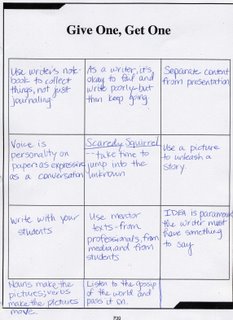
The facilitators led us in thinking about ways to use an activity like this: as a review of the previous day's lesson, as part of a pre-unit assessment, as a lesson summary, or as a unit summary/assessment.
You'd obviously have to be careful about the movement of the students. I don't know that I would do this at the beginning of the year (you know, for a Bingo icebreaker or some such nonsense [remember, I hate icebreakers for adults and as a teacher, I really don't have time]), because I'd want to set routines and expectations. If a class is rowdy, I might not ever do an activity like this. Or if I did, I would make them stay at their tables and give/get that way.
The rest of yesterday was rather pointless. They talked about the writing process. Oh, one guy read a piece and then we had to talk about persuasive writing, what it is and where you find it. I suppose that it was supposed to be a model lesson or something, but I thought it went too long. Since we ARE adults and have a high-level of education, and have all been in the classroom in some capacity, all the detaily stuff could have been skimmed faster.
PS, I get bored and judgy when I'm bored.
During the read-aloud, Oregon was mentioned a couple times. The male facilitator is a hard-core New Yorker with a very strong accent. He pronounced Oregon as "Are-a-gahn". Excuse me, but there is an O at the beginning of the word! Your mouth should make an O when you say a word that starts with one! 'Oregon' is a homophone of 'organ'! Sheesh! Holy crap! That really bugged.
Again, because I'm shallow and judgy, the rest of the accent just grated a lot. This kind of New Yorker talks WAY too loud, practically shouting most of the time. When he moves around the room, a couple times he's stood behind me. I physically wince when he talks near me; it's so damn loud and forceful! He aspirates ALL his consontants.
Put your hand an inch or two in front of your mouth, and say the word "pit." Did you feel the puff of air when you said the P sound? That's an aspirated consonant. Now try to aspirate ALL the consonants in any given word. It's ANNOYING! Shut up, strong-accented New Yorkers!
See? Judgmental. I'm a terrible person.
Ahem. Trying to recover.
Oh, wait. There's more of the judging. A woman at my table is an incessant talker. Not saying anything of worth necessarily, often repeating, just to hear herself talk. That bugs. the. crap. out of me. I want to shriek, Just stop talking, you harpy! Let us listen to the real speakers or at least let someone get a word in edgewise if you're having a 'discussion.' Sheesh.
Okay, really done now.
With the writing process stuff, we took a piece of paper with a T-chart on it; one side said, "I Say" and the other said, "They Say." Under "I Say," we were to write five statements about topics we felt strongly about.
Here are my statements (I'm not very creative; I tend to fall back on the same issues, in case you haven't noticed. Snerk.):
--Travel is a must.
--Reading is a must.
--Reality TV must die.
--The West Coast is better than the East Coast.
--Cats are better than dogs.
Some of my tablemates had things like, "iPods are destroying society"; "Everyone should get free health care"; "Cell phones are a danger to civilization."
We had to do a quick write about one of our topics. I chose the West Coast one, because I'm just that predictable. Yes, I realize that I'm always nattering on about Seattle and the West Coast, and yes, I'm aware that that is irritating and silly. I'm trying to be better. In fact, I've privately assigned myself to write an opposition to the piece. So there. Shut up.
How about this--I'll save my quick write and draft on pro-West until I can do a draft on pro-East, for a separate post. Happy? Then you can just ignore that one.
So today, day two of the workshop proper...
What did we do? Hm. We looked at some more editorials and read a sample lesson from the genre writing book we got yesterday. It talked about the structure of an editorial: position, support, counterargument as the basics. Then we did a jigsaw activity to practice identifying the elements of persuasive writing/editorials.
Jigsaw is an activity where information is split up among groups, and then the groups teach each other. You can do it at least two ways. One way, like some of my colleagues, have each group in their class study, say, a genre of poetry. Then they come up with a full lesson plan and homework, and actually get up to teach the class. At the end, they've all learned at least six types of poetry. The other way is what we did today: count off around the room by fives. Then all the numbers met at different tables. In our number groups ("Expert Groups"), we read one editorial and discussed it and found the persuasive elements. After some time, we returned to our "Home Tables" and each of us took turns briefly explaining about our articles. So that at each table we learned about five different articles and their persuasive elements.
We were told to work on our drafts, and revise them for structure. Oh yeah, we'd had time to examine our drafts and label or identify the structural elements in them. Mine had each argument in a discrete paragraph, and each included both a counterargument and support of my own position. Interesting.
At the end, we received another book, Ralph Fletcher's memoir, Marshfield Dreams. Hurrah for books!
The persuasive stuff and the genre-writing book inspired me to make notes about a persuasive unit with a real debate first and then an editorial. We didn't get to do persuasive writing at all this year; we hardly did anything. I bet, with the right topics, the kids would love and do well on an actual debate. Ideas on topics?
One more day, and I think we may get another book tomorrow. I hope that I can try to make myself enjoy things a little more on the last day!
Monday, July 10, 2006
UFT Workshop with Ralph Fletcher
For all that people speak ill of the UFT, I will pledge myself an avid supporter of the Teacher Center and its programs.
During the year, they sponsor a workshop series (five dates, at the borough offices once a month or so) on various aspects of both literacy and math (separately, of course; do you think we're some kind of commies or something?). They give out at least one book during the year. I think this fall we got one called The No Nonsense Guide to Teaching Writing. Last year we got several, but I can't remember. I know that we each got a couple of content reading books; that was fantastic. Usually the facilitators guide you through ideas and potential lessons. They also have you do reflection and brainstorming and mini-lesson creation, so you do get a lot of resources for your time (4-7, approximately).
Not to mention, you get the standard UFT catered dinner. And best of all, you get training rate--about $18/hour, which after taxes is fifty dollars per session. Pretty sweet deal, if you ask me.
And actually, my other favorite thing, as always, is time to get to know your colleagues in education and your borough. This year, a bunch of teachers in my school signed up for the series. Four of us were in the same room, and it was great to see them in a different capacity than school, and chat (fairly leisurely) as adults, not harried and hurried classroom drones.
Anyway, this week kicks off its summer workshop institute. It goes for four days, also with food (breakfast this time) and resources. The literacy one began this week, and runs again next week. The math one goes in August, I believe.
This one is extra special: today there was a special guest speaker, Ralph Fletcher! In case you aren't familiar with him, he has written a number of books on writing (as in, teaching writing and helping kids improve their writing), especially the writer's notebook. He's written children's fiction and poetry as well.
He discussed many interesting things, illustrated by examples of kids' writing. Writing should be fun and something you chose. The writer's notebook is a place to react to the world. It's not used not only for introspective journaling, but also collecting: poems, drawings, cards, pictures, words or quotes you like, artifacts, memories. He showed us his own (very posh) notebook, in which he had taped many of his own memories and artifacts. He showed two kids' notebooks: one had a piece of balloon from the field day taped in, and the other had the insides of the writer's favorite pen taped in, along with a 'date died.'
He showed us how he discovered a topic he was interested in, like twilight or the moon, and how he wrote as much as could, little bits and pieces in his notebook, and then how those bits eventually grew into real books (Twilight Comes Twice, and Hello, Harvest Moon).
Here's a great activity he had us all do: First he showed us an illustrated map of his own childhood neighborhood, with important places marked. Then he had us draw our own maps of a place we knew well. Then we shared with neighbors.
Here's my terrible map of one of my childhood neighborhoods that I always loved.
During the year, they sponsor a workshop series (five dates, at the borough offices once a month or so) on various aspects of both literacy and math (separately, of course; do you think we're some kind of commies or something?). They give out at least one book during the year. I think this fall we got one called The No Nonsense Guide to Teaching Writing. Last year we got several, but I can't remember. I know that we each got a couple of content reading books; that was fantastic. Usually the facilitators guide you through ideas and potential lessons. They also have you do reflection and brainstorming and mini-lesson creation, so you do get a lot of resources for your time (4-7, approximately).
Not to mention, you get the standard UFT catered dinner. And best of all, you get training rate--about $18/hour, which after taxes is fifty dollars per session. Pretty sweet deal, if you ask me.
And actually, my other favorite thing, as always, is time to get to know your colleagues in education and your borough. This year, a bunch of teachers in my school signed up for the series. Four of us were in the same room, and it was great to see them in a different capacity than school, and chat (fairly leisurely) as adults, not harried and hurried classroom drones.
Anyway, this week kicks off its summer workshop institute. It goes for four days, also with food (breakfast this time) and resources. The literacy one began this week, and runs again next week. The math one goes in August, I believe.
This one is extra special: today there was a special guest speaker, Ralph Fletcher! In case you aren't familiar with him, he has written a number of books on writing (as in, teaching writing and helping kids improve their writing), especially the writer's notebook. He's written children's fiction and poetry as well.
He discussed many interesting things, illustrated by examples of kids' writing. Writing should be fun and something you chose. The writer's notebook is a place to react to the world. It's not used not only for introspective journaling, but also collecting: poems, drawings, cards, pictures, words or quotes you like, artifacts, memories. He showed us his own (very posh) notebook, in which he had taped many of his own memories and artifacts. He showed two kids' notebooks: one had a piece of balloon from the field day taped in, and the other had the insides of the writer's favorite pen taped in, along with a 'date died.'
He showed us how he discovered a topic he was interested in, like twilight or the moon, and how he wrote as much as could, little bits and pieces in his notebook, and then how those bits eventually grew into real books (Twilight Comes Twice, and Hello, Harvest Moon).
Here's a great activity he had us all do: First he showed us an illustrated map of his own childhood neighborhood, with important places marked. Then he had us draw our own maps of a place we knew well. Then we shared with neighbors.
Here's my terrible map of one of my childhood neighborhoods that I always loved.
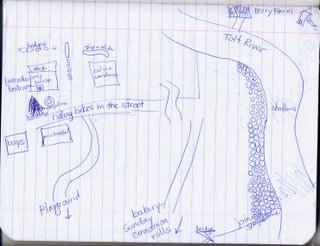 It's Carnation, a tiny town in the rural outskirts of the suburbs. The four boxes are our old house and the surrounding three houses. There were kids in all four, and we all played together. Next door had a Slip and Slide, so most of the summer play was in their backyard. They also had a weiner dog that chased me around my own house. We sometimes played with a trampoline in our front yard. We all always rode our bikes in the street.
Nearby was a little playground. A little further on was the bakery where we usually got cinnamon rolls on Sunday mornings.
The best part of Carnation was the river. The Tolt is a quiet, meandering and rocky little river that joins the larger and sandier Snoqualmie River right up the road. We went there all the time, decked out with actual tennis shoes to walk (more) comfortably on the rocks of the 'beach' and in the river itself. Occasionally we brought inner tubes to float on the gentle current (though we'd have to 'portage' in the rocky shallows). It was always a pleasant and fun place to be. Even more so on those really hot days; the river comes right from mountain streams and is freezing cold.
Down the road and around the bend is Remlinger Farms, where you can pick berries, pumpkins, and probably other things too. They sell food and treats and crafty things in their barn store. It always smelled good in there, both earthy and slightly sugary.
Once we all had drawn and shared, he guided us in marking: a power spot, where people gathered; a danger spot where you weren't supposed to go; a favorite place; and a secret spot.
The idea is that you can take this one activity and easily pull from your many experiences at least one spark of an idea to create a writing piece.
Here's another one ripe with sparks: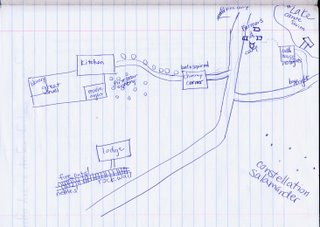
I drew a map of Trailblazers. I could more easily mark stories on that one: the place where I spotted the first bear of our adventure; the bath house with no electricity; the corner where all the boys scared the crap out of all us girls returning up the dark road late at night; the rock wall that we dug up and got attacked by fire ants and nettles; the smallcamp where we built our most-excellent round-to; the cabin we lived in with a bat and a flying squirrel; the lake where we canoed to the far camp and once went swimming; the dock where we had to scrape paint; the corner room in the dining hall where we had a slumber party, covering the floor in a double-layer of camp mattresses, building a roaring fire and watching an 80s movie. Oh, and that's the constellation that I used to look at when I walked to the dock at night with no flashlight to challenge my bravery and nightvision.
The last section of his talk was about the Qualities of Writing: Ideas, Design, Language, Presentation, all of which should be infused with Voice. Additionally, writing should have good Organization, Focus, Beginnings, Endings, Time, and Shape.
He read us a splendid and hilarious book, called Scaredy Squirrel by Melanie Watt. It's about a paranoid squirrel who eventually finds that he can safely explore more of the world outside his tree. It helps us think about conquering the fear of the unknown.
Mr Fletcher was a lively and engaging speaker with plenty of entertaining examples. I really feel reinvigorated about teaching writing to my kids this fall. I think I'll have to make them get three notebooks: one as a writer's notebook, one as a reading response book, and one as a workbook (for notes and things). I will ask them to do this mapping activity, list important moments in their lives so far, write about moving/friends/family/pets, find interesting words and snippets of their books, things they wonder about, describe their environments in new and vivid ways, and listen to the world around them, noise from nature and humans alike.
Yet another summer to-do will have to be writing about all these things myself! It's been awhile since I did any journal writing. It'll be really fun to share my work with the kids and have them share theirs.
I sure hope that some of this will also inspire you to think about writing in a new way. If you are a teacher in any grade, I highly recommend Ralph Fletcher's books, for you and for your students.
I'm excited for the next three days of this workshop!
Tuesday, September 13, 2005
Same shit, more bureaucratical minutiae
It's not a "Do Now," it's a "Motivation."
We may NOT abbreviate "instructional objective." We must actually write out those two long words every day. Because, of course, we have NOTHING else to do with our time than play at the fucking chalkboard.
Ahem.
Day Four (good god, is that all??) went well also. Pretty mundane stuff today, housekeeping and that kind of thing. My Do Now--er, Motivation (and you bet your ass I told my students about the joys of bureaucratic demands) was to list the parts of speech. Do you know, NONE of the students had any idea what that meant. Now, when someone suggested "noun" or "verb" they all went "oh!" But I took the opportunity (that's called the Teachable Moment, in case any administrators happened by...) to review the better-known parts of speech: noun, verb, adjective, adverb, proper noun, pronoun.
While in the hallway with one of my classes, playing my drill sergeant role etc, I glimpsed Mr Cute Teacher, watching bemusedly. And I totally cracked. Thank god I wasn't facing my kids when I broke into a grin. I can't have distractions like that when I am acting like a tough teacher! It's kind of fun, and after all, once I realized I couldn't be an Olympic gymnast (shut up), I wanted to be an actor. I don't get paid to act per se, but it's pretty damn close, huh?
People are still giving me lots of compliments on my professional outfits and stern demeanor with the kids. Yay!
This week, let's see, three more days, I am giving a reading benchmark test, the language assessment, plus at some point I have to begin introducing the four square, not to mention starting the goddamn reading and writing workshops. Um yeah, three days. Sure.
Next week-ish (emphasis on the "ish") I need to start story writing. I found an excellent packet of lesson things from Teaching That Makes Sense. I really like all their stuff, so English or writing teachers, check them out.
We may NOT abbreviate "instructional objective." We must actually write out those two long words every day. Because, of course, we have NOTHING else to do with our time than play at the fucking chalkboard.
Ahem.
Day Four (good god, is that all??) went well also. Pretty mundane stuff today, housekeeping and that kind of thing. My Do Now--er, Motivation (and you bet your ass I told my students about the joys of bureaucratic demands) was to list the parts of speech. Do you know, NONE of the students had any idea what that meant. Now, when someone suggested "noun" or "verb" they all went "oh!" But I took the opportunity (that's called the Teachable Moment, in case any administrators happened by...) to review the better-known parts of speech: noun, verb, adjective, adverb, proper noun, pronoun.
While in the hallway with one of my classes, playing my drill sergeant role etc, I glimpsed Mr Cute Teacher, watching bemusedly. And I totally cracked. Thank god I wasn't facing my kids when I broke into a grin. I can't have distractions like that when I am acting like a tough teacher! It's kind of fun, and after all, once I realized I couldn't be an Olympic gymnast (shut up), I wanted to be an actor. I don't get paid to act per se, but it's pretty damn close, huh?
People are still giving me lots of compliments on my professional outfits and stern demeanor with the kids. Yay!
This week, let's see, three more days, I am giving a reading benchmark test, the language assessment, plus at some point I have to begin introducing the four square, not to mention starting the goddamn reading and writing workshops. Um yeah, three days. Sure.
Next week-ish (emphasis on the "ish") I need to start story writing. I found an excellent packet of lesson things from Teaching That Makes Sense. I really like all their stuff, so English or writing teachers, check them out.
Tuesday, September 06, 2005
Oy.
I am ridiculously tired.
From 3.30 to 6.00, I was kind of just pretending to sleep. But when the alarm went off, I was able to get up just fine. Off I scurried, to get ready and then get in my car (my car! ee!), to drive to school. Which only took twenty minutes. I arrived, fresh-faced, just in time to park behind CuteTeacher. Teehee.
All morning was spent greeting colleagues and chatting about everyone's summers and comparing class schedules. We had a staff meeting, and I was newly inspired by my principal, who discussed how his own father had been going down all the wrong paths. When a teacher at school helped get him on track, it helped Mr Principal's dad to then succeed and become a professional. However, it also helped Mr Principal, and is helping Mr Principal's own son. So he reminded us that the impact we have affects not just the students we have now, but the children of generations to come.
After lunch, there was a quick department meeting. We got class lists! And some other English -related stuff. Our first mini-unit will be short story writing for four weeks, then four weeks of poetry. Four weeks to write a story?! Oh, and I have very exciting news. Out of the 99 students (I know--yikes), guess how many level 2's I have? THREE. Guess how many level 1's? ZERO!! This year's crop of kids are much higher-level all together than last year's. Sweet! Let's hope that will help affect behavior as well.
I spent all afternoon--about three and a half hours--working on my classroom. I did pretty good, got a good bit done. Not nearly finished, of course, but still, good progress. Word wall bulletin board is up. Desk is together. New bookshelf has piles of books on it. (As part of the lesson on genre, the students will sort all the books later.) Welcome sign completed and taped to the door. List of charts to make on my chalkboard. Pile of other charts and signs on table to be put up.
My 417 copies, plus two enlargements, at Staples cost $37! Damn.
Almost nine and I am pretty exhausted. Am heading to shower and bed asap. Mm, sleep.
{don't think about students coming the day after tomorrow. don't think about it at all. that way, you can catch up on sleep. DON'T THINK!}
From 3.30 to 6.00, I was kind of just pretending to sleep. But when the alarm went off, I was able to get up just fine. Off I scurried, to get ready and then get in my car (my car! ee!), to drive to school. Which only took twenty minutes. I arrived, fresh-faced, just in time to park behind CuteTeacher. Teehee.
All morning was spent greeting colleagues and chatting about everyone's summers and comparing class schedules. We had a staff meeting, and I was newly inspired by my principal, who discussed how his own father had been going down all the wrong paths. When a teacher at school helped get him on track, it helped Mr Principal's dad to then succeed and become a professional. However, it also helped Mr Principal, and is helping Mr Principal's own son. So he reminded us that the impact we have affects not just the students we have now, but the children of generations to come.
After lunch, there was a quick department meeting. We got class lists! And some other English -related stuff. Our first mini-unit will be short story writing for four weeks, then four weeks of poetry. Four weeks to write a story?! Oh, and I have very exciting news. Out of the 99 students (I know--yikes), guess how many level 2's I have? THREE. Guess how many level 1's? ZERO!! This year's crop of kids are much higher-level all together than last year's. Sweet! Let's hope that will help affect behavior as well.
I spent all afternoon--about three and a half hours--working on my classroom. I did pretty good, got a good bit done. Not nearly finished, of course, but still, good progress. Word wall bulletin board is up. Desk is together. New bookshelf has piles of books on it. (As part of the lesson on genre, the students will sort all the books later.) Welcome sign completed and taped to the door. List of charts to make on my chalkboard. Pile of other charts and signs on table to be put up.
My 417 copies, plus two enlargements, at Staples cost $37! Damn.
Almost nine and I am pretty exhausted. Am heading to shower and bed asap. Mm, sleep.
{don't think about students coming the day after tomorrow. don't think about it at all. that way, you can catch up on sleep. DON'T THINK!}
Subscribe to:
Posts (Atom)